
|
You entered: ring
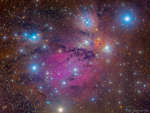 NGC 2170: Angel Nebula Still Life
26.08.2019
Is this a painting or a photograph? In this classic celestial still life composed with a cosmic brush, dusty nebula NGC 2170, also known as the Angel Nebula, shines near the image center. Reflecting...
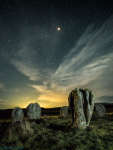 Mars over Duddo Stone Circle
23.03.2021
Why are these large stones here? One the more famous stone circles is the Duddo Five Stones of Northumberland, England. Set in the open near the top of a modest incline, a short hike across empty fields will bring you to unusual human -sized stones that are unlike anything surrounding them.
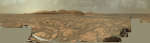 Curiosity: Sol 3048
25.03.2021
Before Perseverance there was Curiosity. In fact, the Curiosity rover accomplished the first sky crane maneuver touchdown on Mars on April 5, 2012. March 2, 2021 marked Curiosity's 3,048th martian day operating on the surface of the Red Planet.
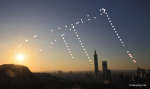 Analemma over Taipei
21.06.2022
Does the Sun return to the same spot on the sky every day? No. A better and more visual answer to that question is an analemma, a composite of images taken at the same time and from the same place over the course of a year.
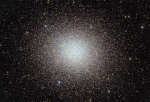 Millions of Stars in Omega Centauri
16.03.2023
Globular star cluster Omega Centauri, also known as NGC 5139, is 15,000 light-years away. The cluster is packed with about 10 million stars much older than the Sun within a volume about 150 light-years in diameter.
 Stereo Jupiter near Opposition
24.11.2023
Jupiter looks sharp in these two rooftop telescope images. Both were captured on November 17 from Singapore, planet Earth, about two weeks after Jupiter's 2023 opposition. Climbing high in midnight skies the giant planet was a mere 33.4 light-minutes from Singapore. That's about 4 astronomical units away.
 APOD: 2024 June 26 Б Timelapse: Aurora, SAR, and the Milky Way
26.06.2024
What's happening in the sky this unusual night? Most striking in the featured 4.5-hour 360-degree panoramic video, perhaps, is the pink and purple aurora. That's because this night, encompassing May 11, was famous for its auroral skies around the world.
 APOD: 2024 September 18 Б The Mermaid Nebula Supernova Remnant
18.09.2024
New stars are born from the remnants of dead stars. The gaseous remnant of the gravitational collapse and subsequent death of a very massive star in our Milky Way created the G296.5+10.0 supernova remnant, of which the featured Mermaid Nebula is part.
 Deimos Before Sunrise
24.05.2025
Deimos takes 30 hours and 18 minutes to complete one orbit around the Red Planet. That's a little more than one Martian day or sol which is about 24 hours and 40 minutes long, so Deimos drifts westward across the Martian sky.
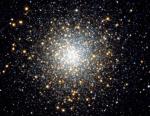 Hydrogen, Helium, and the Stars of M10
30.06.2001
Stars like the Sun use hydrogen for fuel, "burning" hydrogen into helium at their cores through nuclear fusion. But what happens when that hydrogen runs out? For a while, hydrogen burns in a shell surrounding the stellar core and the star expands to become a red giant.
|
January February March April May June July August September October |
|||||||||||||||||||||||||||||||||||||||||||||||||