
|
You entered: ring
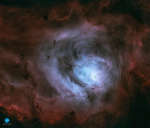 The Lagoon Nebula without Stars
8.08.2022
Ridges of glowing interstellar gas and dark dust clouds inhabit the turbulent, cosmic depths of the Lagoon Nebula. Also known as M8, the bright star forming region is about 5,000 light-years distant.
 APOD: 2023 July 26 Б IC 4628: The Prawn Nebula
26.07.2023
South of Antares, in the tail of the nebula-rich constellation Scorpius, lies emission nebula IC 4628. Nearby hot, massive stars, millions of years young, irradiate the nebula with invisible ultraviolet light, stripping electrons from atoms. The electrons eventually recombine with the atoms to produce the visible nebular glow, dominated by the red emission of hydrogen.
 The Medusa Nebula
22.11.2024
Braided and serpentine filaments of glowing gas suggest this nebula's popular name, The Medusa Nebula. Also known as Abell 21, this Medusa is an old planetary nebula some 1,500 light-years away in the constellation Gemini. Like its mythological namesake, the nebula is associated with a dramatic transformation.
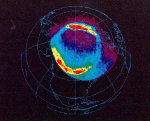 Aurora Crown the Earth
27.05.1996
What do aurora look like from space? The POLAR spacecraft answered this by photographing an auroral oval surrounding the north pole of the Earth, causing displays on both the night and day side. The auroral sub-storm, pictured in false-color above, developed within 15 minutes and may have lasted as long as on hour.
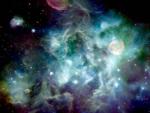 A Radio Vista of Cygnus
18.02.2002
Shells of ancient supernovas, cocoons surrounding newborn stars, and specks from distant quasars highlight this tremendous vista toward the constellation of Cygnus. The representative color image covers about 10 degrees across on the sky but is only a small part of the Canadian Galactic Plane Survey in radio light.
 Jupiter from Voyager
25.06.1995
Imagine a hurricane that lasted for 300 years! This picture of the planet Jupiter was taken by the Voyager 1 spacecraft as it passed the planet in 1979. Jupiter, a gas giant planet with no solid surface, is the largest planet in the solar system and is made mostly of the hydrogen and helium.
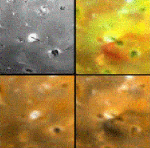 Volcano Euboea Fluctus On Io
8.09.1996
Jupiter's moon Io is turning out to be our Solar System's geologic powerhouse. The churning moon was photographed again just recently on June 27th and again shows signs of violent activity. Shown above are photographs of the volcano Euboea Fluctus taken at different times.
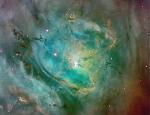 Stars and Dust of the Lagoon Nebula
8.09.2003
The large majestic Lagoon Nebula is home for many young stars and hot gas. Spanning 100 light years across while lying only about 5000 light years distant, the Lagoon Nebulae is so big and bright that it can be seen without a telescope toward the constellation of Sagittarius.
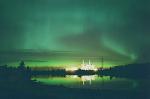 Aurora Over Edmonton
4.11.2003
Northern and southern locales saw many a beautiful aurora over the last week, as particles from several large solar flares impacted the Earth. Many reported unusually red auroras, although colors across the spectrum were also seen. Power grids and orbiting satellites braced for the onslaught, but little lasting damage was reported.
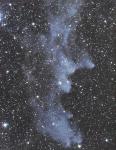 The Witch Head Nebula
29.12.2003
Double, double toil and trouble; Fire burn, and cauldron bubble -- maybe Macbeth should have consulted the Witch Head Nebula. This suggestively shaped reflection nebula is associated with the bright star Rigel in the constellation Orion.
|
January February March April May June July August September October |
|||||||||||||||||||||||||||||||||||||||||||||||||