
|
You entered: ring
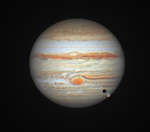 In Ganymede s Shadow
7.10.2022
At opposition, opposite the Sun in Earth's sky, late last month Jupiter is also approaching perihelion, the closest point to the Sun in its elliptical orbit, early next year. That makes Jupiter exceptionally close to our fair planet, currently resulting in excellent views of the Solar System's ruling gas giant.
 APOD: 2023 May 29 Б Milky Way over a Turquoise Wonderland
29.05.2023
What glows there? The answer depends: sea or sky? In the sea, the unusual blue glow is bioluminescence. Specifically, the glimmer arises from Noctiluca scintillans, single-celled plankton stimulated by the lapping waves. The plankton use their glow to startle and illuminate predators.
 APOD: 2024 February 14 Б Rosette Deep Field
14.02.2024
Can you find the Rosette Nebula? The large, red, and flowery-looking nebula on the upper left may seem the obvious choice, but that is actually just diffuse hydrogen emission surrounding the Cone and Fox Fur Nebulas.
 Saturn at the Moon s Edge
27.07.2024
Saturn now rises before midnight in planet Earth's sky. On July 24, the naked-eye planet was in close conjunction, close on the sky, to a waning gibbous Moon. But from some locations...
 APOD: 2025 August 5 Б NGC 6072: A Complex Planetary Nebula from Webb
5.08.2025
Why is this nebula so complex? The Webb Space Telescope has imaged a nebula in great detail that is thought to have emerged from a Sun-like star. NGC 6072 has been resolved into one of the more unusual and complex examples of planetary nebula.
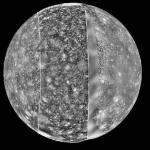 Callisto Full Face
9.12.1996
Callisto's surface shows its age. While probably formed at the same time as Io, the difference between the surfaces of these two moons of Jupiter could hardly be greater. Io's surface is young, shows practically no impact craters, and is continually being repaved by the lava exploding from its many large volcanoes.
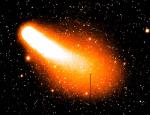 Comet Linear (WM1) Brightens
6.12.2001
A comet bright enough to be seen with binoculars is swooping into southern skies. Comet C/2000 WM1 (LINEAR) continues to brighten and develop tails as it nears its closest approach of the Sun in late January 2002.
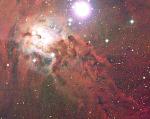 The Fox Fur Nebula
1.07.2002
The nebula surrounding bright star S Mon is filled with dark dust and glowing gas. The strange shapes that surrounding this star originate from fine interstellar dust reacting in complex ways with the energetic light and hot gas being expelled by the young stars.
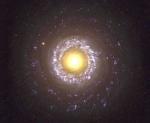 Spiral Galaxy NGC 7742
26.07.2003
This might resemble a fried egg you've had for breakfast, but it's actually much larger. In fact, ringed by blue-tinted star forming regions and faintly visible spiral arms, the yolk-yellow center of this face-on spiral galaxy, NGC 7742, is about 3,000 light-years across.
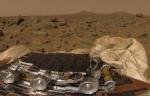 Pathfinder on Mars
5.07.1997
Yesterday, July 4th, using its own array of fireworks, a parachute, and a cocoon of airbags, the Mars Pathfinder spacecraft successfully bounced and came to rest on the surface of Mars at 10:07 AM Pacific Daylight Time.
|
January February March April May June July August September October |
|||||||||||||||||||||||||||||||||||||||||||||||||