
|
You entered: ring
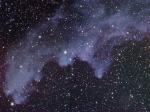 IC 2118: The Witch Head Nebula
26.12.2005
Double, double toil and trouble; Fire burn, and cauldron bubble -- maybe Macbeth should have consulted the Witch Head Nebula. This suggestively shaped reflection nebula is associated with the bright star Rigel in the constellation Orion.
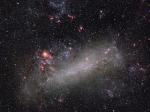 The Large Cloud of Magellan
10.05.2006
Portuguese navigator Fernando de Magellan and his crew had plenty of time to study the southern sky during the first circumnavigation of planet Earth. As a result, two fuzzy cloud-like objects easily visible for southern hemisphere skygazers are known as the Clouds of Magellan.
 The Belt of Venus over the Valley of the Moon
23.07.2006
Although you've surely seen it, you might not have noticed it. During a cloudless twilight, just before sunrise or after sunset, part of the atmosphere above the horizon appears slightly off-color, slightly pink.
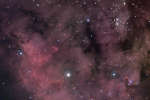 The Star Pillars of Sharpless 171
18.10.2009
Towering pillars of cold gas and dark dust adorn the center star forming region of Sharpless 171. An open cluster of stars is forming there from the gas in cold molecular clouds. As energetic...
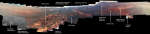 Perseverance Valley Panorama
13.03.2019
Mars exploration rover Opportunity's parting panorama from Perseverance Valley spans 360 degrees in this false color mosaic. The scene is composed of 354 individual images recorded through 3 different color filters by the rover's panoramic camera from May 13 through June 10, 2018.
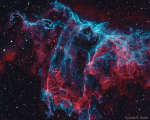 NGC 6995: The Bat Nebula
24.11.2019
Do you see the bat? It haunts this cosmic close-up of the eastern Veil Nebula. The Veil Nebula itself is a large supernova remnant, the expanding debris cloud from the death explosion of a massive star.
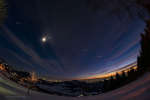 Planetary Alignment over Italy
18.12.2021
It is not a coincidence that planets line up. That's because all of the planets orbit the Sun in (nearly) a single sheet called the plane of the ecliptic. When viewed from inside that plane -- as Earth dwellers are likely to do -- the planets all appear confined to a single band.
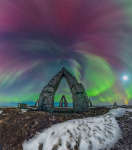 APOD: 2023 March 27 Б Aurora Over Arctic Henge
26.03.2023
Reports of powerful solar flares started a seven-hour quest north to capture modern monuments against an aurora-filled sky. The peaks of iconic Arctic Henge in Raufarhцfn in northern Iceland were already aligned with the stars: some are lined up toward the exact north from one side and toward exact south from the other.
 APOD: 2025 May 12 Б Gaia Reconstructs a Side View of our Galaxy
11.05.2025
What does our Milky Way Galaxy look like from the side? Because we are on the inside, humanity canБt get an actual picture. Recently, however, just such a map has been made using location data for over a billion stars from ESAБs Gaia mission.
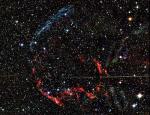 Galactic Supernova Remnant IC 443
21.07.1999
About 8000 years ago, a star in our Galaxy exploded. Ancient humans might have noticed the supernova as a temporary star, but modern humans can see the expanding shell of gas even today.
|
January February March April May June July August September October |
|||||||||||||||||||||||||||||||||||||||||||||||||