
|
You entered: Chandra
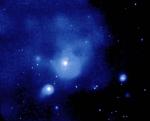 Fornax Cluster in Motion
24.09.2004
Reminiscent of popular images of the lovely Pleiades star cluster that lies within our own Milky Way Galaxy, this false-color x-ray view actually explores the center of a much more extended cosmic family -- the Fornax cluster of galaxies some 65 million light-years away.
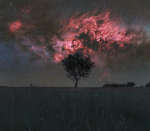 APOD: 2026 March 18 Б Cygnus and the Solitary Tree
18.03.2026
A lone tree stands in a quiet meadow in Guadalajara, Spain, silhouetted against the Cygnus region rising above like flames in the night sky. This deep night skyscape is a composite of exposures that reveals a range of brightness and color human eyes can't quite see on their own.
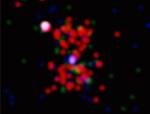 3C294: Distant X Ray Galaxy Cluster
22.02.2001
Large clusters of galaxies are the most massive objects in the universe. Astronomers now realize that a hallmark of these cosmic behemoths are gas clouds with temperatures of tens of millions of degrees that pervade the clusters and radiate strongly in x-rays.
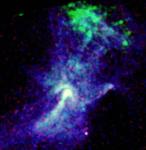 X Rays And The Circinus Pulsar
13.09.2001
A bizarre stellar corpse 19,000 light-years from Earth, pulsar PSR B1509-58 beckons from the small southern constellation of Circinus. Like its cousin at the heart of the Crab nebula, the Circinus pulsar is a rapidly spinning, magnetized neutron star.
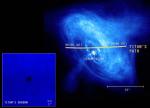 Titan s X Ray
29.04.2004
This June's rare and much heralded transit of Venus will feature our currently brilliant evening star in silhouette, as the inner planet glides across the face of the Sun. But on January 5, 2003 and even rarer transit took place.
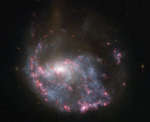 NGC 922: Collisional Ring Galaxy
17.12.2012
Why does this galaxy have so many big black holes? No one is sure. What is sure is that NGC 922 is a ring galaxy created by the collision of a large and small galaxy about 300 million years ago.
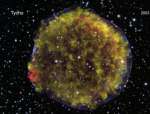 Tychos Supernova Remnant Expands
1.06.2016
What star created this huge expanding puffball? Featured here is the first expansion movie ever created for Tycho's supernova remnant, the result of a stellar explosion first recorded over 400 years ago by the famous astronomer Tycho Brahe.
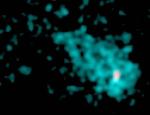 IC443's Neutron Star
15.12.2000
Using x-ray data from the orbiting Chandra Observatory along with radio data from the Very Large Array, a team of researchers has discovered evidence for a new example of one of the most bizarre objects known to modern astrophysics -- a neutron star.
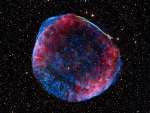 SN 1006 Supernova Remnant
4.07.2008
A new star, likely the brightest supernova in recorded human history, lit up planet Earth's sky in the year 1006 AD. The expanding debris cloud from the stellar explosion, found in the southerly constellation of Lupus, still puts on a cosmic light show across the electromagnetic spectrum.
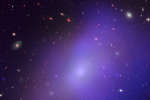 Elliptical Galaxy NGC 1132
13.02.2008
NGC 1132 is one smooth galaxy -- but how did it form? As an elliptical galaxy, NGC 1132 has little dust and gas, and few stars have formed in it recently. Although many elliptical galaxies are in clusters of galaxies, NGC 1132 appears as a large, isolated galaxy toward the constellation of the River (Eridanus).
|
January February March April May June July August September |
|||||||||||||||||||||||||||||||||||||||||||||||||