
|
You entered: gravity
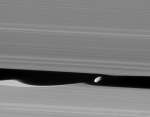 Daphnis the Wavemaker
21.01.2017
Plunging close to the outer edges of Saturn's rings, on January 16 the Cassini spacecraft captured this closest yet view of Daphnis. About 8 kilometers across and orbiting within the bright ring system's Keeler gap, the small moon is making waves.
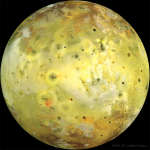 Io in True Color
11.12.2022
The strangest moon in the Solar System is bright yellow. The featured picture, an attempt to show how Io would appear in the "true colors" perceptible to the average human eye, was taken in 1999 July by the Galileo spacecraft that orbited Jupiter from 1995 to 2003.
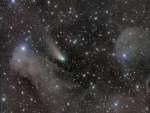 Outbound Comet ZTF
24.03.2023
Former darling of the northern sky Comet C/2022E3 (ZTF) has faded. During its closest approach to our fair planet in early February Comet ZTF was a mere 2.3 light-minutes distant. Then known as the green comet, this visitor from the remote Oort Cloud is now nearly 13.3 light-minutes away.
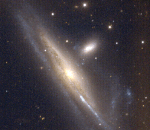 Interacting Galaxies
10.07.1998
This dramatic image of an interacting pair of galaxies was made using the 1.5 meter telescope at the Cerro Tololo Inter-American Observatory near La Serena, Chile. NGC 1531 is the background galaxy with a bright core just above center and NGC 1532 is the foreground spiral galaxy laced with dust lanes.
 Prometheus and the Rings of Saturn
17.12.2004
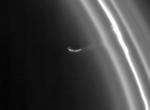
In Greek Mythology, Prometheus was known for stealing fire from the gods. Ironically, in a story for more modern times Prometheus may also become known for stealing, but this time for stealing icy particles from Saturn's rings.
 Mercurys Horizon from MESSENGER
21.01.2008
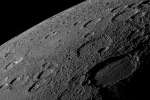
What would it look like to fly past Mercury? Just such an adventure was experienced last week by the MESSENGER spacecraft during its first flyby of the strange moon-like world nearest the Sun. Pictured above is the limb of Mercury seen by MESSENGER upon approach, from about 1 1/2 Earth diameters away.
 A Galaxy Collision in NGC 6745
30.09.2012
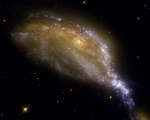
Galaxies don't normally look like this. NGC 6745 actually shows the results of two galaxies that have been colliding for only hundreds of millions of years. Just off the above digitally sharpened photograph to the lower right is the smaller galaxy, moving away.
 Galaxy Evolution Tracking Animation
30.05.2016
How did the universe evolve from such a smooth beginning? To help understand, computational cosmologists and NASA produced the featured time-lapse animated video depicting a computer simulation of part of the universe. The 100-million light-year simulation starts about 20 million years after the Big Bang and runs until the present.
 APOD: 2025 April 7 Б NGC 4414: A Flocculent Spiral Galaxy
7.04.2025
How much mass do flocculent spirals hide? The featured image of flocculent spiral galaxy NGC 4414 was taken with the Hubble Space Telescope to help answer this question. Flocculent spirals -- galaxies without well-defined spiral arms -- are a quite common form of galaxy, and NGC 4414 is one of the closest.
 Barred Spiral Galaxy NGC 2903
21.03.2001
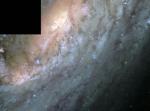
NGC 2903 is a spiral galaxy similar to our own Milky Way Galaxy. Similarities include its general size and a central bar. One striking difference, however, is the appearance of mysterious hot spots in NGC 2903's core. Upon
|
January February March April May June July August September October |
|||||||||||||||||||||||||||||||||||||||||||||||||