
|
You entered: gravity
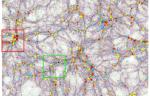 Finding Dark Matter
19.12.2001
Where is dark matter? Galaxies rotate and move in clusters as if a tremendous amount of unseen matter is present. But does dark matter exist in the greater universe too -- and if so, where? The answer can be found by comparing the distribution of galaxies observed with numerical simulations.
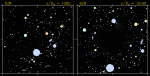 Too Close to a Black Hole
5.01.1997
What would you see if you went right up to a black hole? Above are two computer generated pictures highlighting how strange things would look. On the left is a normal star field containing the constellation Orion. Notice the three stars of nearly equal brightness that make up Orion's Belt.
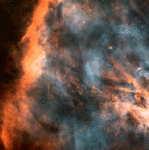 The Great Nebula in Orion
3.07.1995
The Great Nebula in Orion, M42, can be found on the night sky just below and to the left of the easily identifiable belt of three stars in the popular constellation Orion. This nebula is one of the closest stellar nurseries - where young stars are being formed even now.
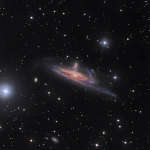 Galaxies in the River
8.01.2020
Large galaxies grow by eating small ones. Even our own galaxy engages in a sort of galactic cannibalism, absorbing small galaxies that are too close and are captured by the Milky Way's gravity.
 APOD: 2024 December 16 Б A Kilometer High Cliff on Comet Churyumov Gerasimenko
16.12.2024
This kilometer high cliff occurs on the surface of a comet. It was discovered on the dark nucleus of Comet Churyumov - Gerasimenko (CG) by Rosetta, a robotic spacecraft launched by ESA, which orbited the comet from 2014 to 2016. The ragged cliff, as featured here, was imaged by Rosetta early in its mission.
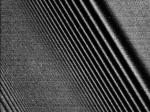 Cassini Images Density Waves in Saturns Rings
5.07.2004
What causes the patterns in Saturn's rings? The Cassini spacecraft just entering orbit around Saturn has started sending back spectacular images of Saturn's immense ring system in unprecedented detail. The physical cause for many of newly resolved ring structures is not always understood.
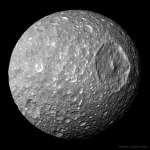 Mimas: Small Moon with a Big Crater
31.05.2021
Whatever hit Mimas nearly destroyed it. What remains is one of the largest impact craters on one of Saturn's smallest round moons. Analysis indicates that a slightly larger impact would have destroyed Mimas entirely.
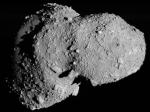 The Missing Craters of Asteroid Itokawa
21.11.2005
Where are the craters on asteroid Itokawa? No one knows. The Japanese robot probe Hayabusa recently approached the Earth-crossing asteroid and is returning pictures showing a surface unlike any other Solar System body yet photographed -- a surface possibly devoid of craters.
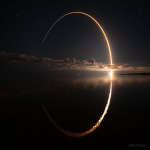 Lucy Launches to Eight Asteroids
20.10.2021
Why would this mission go out as far as Jupiter -- but then not visit Jupiter? Lucy's plan is to follow different leads about the origin of our Solar System than can be found at Jupiter -- where Juno now orbits.
 APOD: 2024 September 16 Б Mercurys Vivaldi Crater from BepiColombo
16.09.2024
Why does this large crater on Mercury have two rings and a smooth floor? No one is sure. The unusual feature called Vivaldi Crater spans 215 kilometers and was imaged again in great detail by ESA's and JAXA's robotic BepiColombo spacecraft on a flyby earlier this month.
|
January February March April May June July August September October |
|||||||||||||||||||||||||||||||||||||||||||||||||