
|
You entered: gravity
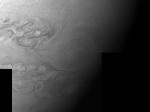 New Horizons Spacecraft Passes Jupiter
7.03.2007
A new spacecraft is headed for the outer Solar System. Named New Horizons, this robotic explorer passed Jupiter last week after being launched only in early 2006. New Horizons is being pulled by Jupiter's gravity to a greater speed toward its next target: Pluto in 2015.
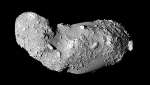 The Missing Craters of Asteroid Itokawa
9.02.2014
Where are the craters on asteroid Itokawa? Missing -- unexpectedly. The Japanese robot probe Hayabusa approached the Earth-crossing asteroid in 2005 and returned pictures showing a surface unlike any other Solar System body yet photographed -- a surface possibly devoid of craters.
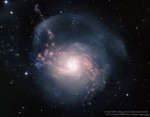 NGC 3310: A Starburst Spiral Galaxy
1.03.2016
The party is still going on in spiral galaxy NGC 3310. Roughly 100 million years ago, NGC 3310 likely collided with a smaller galaxy causing the large spiral galaxy to light up with a tremendous burst of star formation.
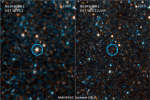 The Case of the Missing Star
6.06.2017
What's happened to giant star N6946-BH1? It was there just a few years ago -- Hubble imaged it. Now there's only a faint glow. What's curiouser, no bright supernova occurred -- although the star did brightened significantly for a few months.
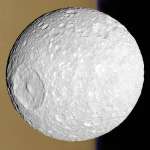 Mimas: Small Moon with a Big Crater
21.10.2014
Whatever hit Mimas nearly destroyed it. What remains is one of the largest impact craters on one of Saturn's smallest moons. The crater, named Herschel after the 1789 discoverer of Mimas, Sir William Herschel, spans about 130 kilometers and is pictured above.
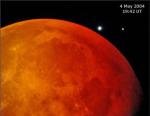 Zubenelgenubi and Friends
14.05.2004
Moderately bright Zubenelgenubi is the star just off the upper right hand limb of an eclipsed Moon in this telescopic view from Port Elizabeth, South Africa. Actually the second brightest star in the constellation...
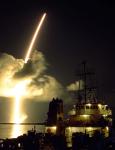 Cassini To Venus
16.10.1997
NASA's Saturn Explorer Cassini with ESA's Titan Probe Huygens attached successfully rocketed into the skies early yesterday morning. The mighty Titan 4B Centaur rocket is seen here across the water gracefully arcing away from Launch Complex 40 at Cape Canaveral Air Station.
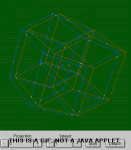 A Higher Dimensional Universe
18.03.2007
Does our universe have higher but unusual spatial dimensions? This idea has been gaining popularity to help explain why vastly separated parts of our universe appear so similar, and why the geometry of our universe does not seem to result naturally from the amounts of matter it seems to contain.
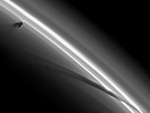 Prometheus Creating Saturn Ring Streamers
27.04.2009
What's causing those strange dark streaks in the rings of Saturn? Prometheus. Specifically, an orbital dance involving Saturn's moon Prometheus keeps creating unusual light and dark streamers in the F-Ring of Saturn. Now Prometheus orbits Saturn just inside the thin F-ring, but ventures into its inner edge about every 15 hours.
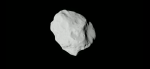 Rosetta Approaches Asteroid Lutitea
24.04.2012
What would it look like to approach an asteroid in a spaceship? In 2010, ESA's robotic Rosetta spacecraft zipped past the asteroid 21 Lutetia taking data and snapping images in an effort to better determine the history of the asteroid and the origin of its unusual colors.
|
January February March April May June July August September October |
|||||||||||||||||||||||||||||||||||||||||||||||||