
|
You entered: gravity
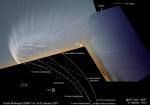 A Tail of Two Hemispheres
1.02.2007
By January 19/20 Comet McNaught's magnificent dust tail stretched for about 150 million kilometers (~1 AU), requiring images from both southern and northern hemispheres of planet Earth to take it all in.
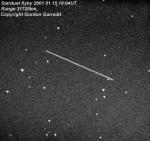 Sail On Stardust
25.01.2001
Spacecraft on long interplanetary voyages often use the planets themselves as gravitational "sling shots" to boost them along their way. Launched in February of 1999 on a historic voyage to a comet, the Stardust spacecraft is no different.
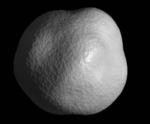 Asteroid 1998 KY26
19.09.2002
A day is just under 11 minutes long on 1998 KY26, a 30 meter wide, fast-spinning, water-rich asteroid. This computer simulated view of its lumpy surface has a resolution of about 3 meters and is based on radar and optical observations (click on the image for a series of surface views).
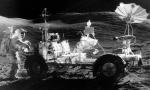 Apollo 17's Lunar Rover
1.07.1999
In December of 1972, Apollo 17 astronauts Eugene Cernan and Harrison Schmitt spent about 75 hours exploring the Moon's Taurus-Littrow valley while colleague Ronald Evans orbited overhead. Cernan and Schmitt were the last humans to walk or ride on the Moon - aided in their explorations by a Lunar Roving Vehicle.
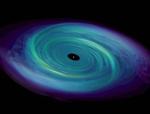 Accretion Disk Simulation
27.09.2002
Don't be fooled by the familiar symmetry. The graceful spiral structure seen in this computer visualization does not portray winding spiral arms in a distant galaxy of stars. Instead, the graphic shows spiral...
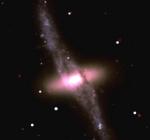 NGC 4650A: Strange Galaxy and Dark Matter
25.06.1998
This strangely distorted galaxy of stars is cataloged as NGC 4650A. It lies about 165 million light-years away in the southern constellation Centaurus. The complex system seems to have at least two parts, a flattened disk of stars with a dense, bright, central core and a sparse, sharply tilted ring of gas, dust and stars.
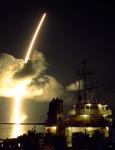 Cassini to Venus
3.07.2004
Saturn Orbiter Cassini with Titan Probe Huygens attached rocketed into early morning skies on October 15, 1997. The mighty Titan 4B Centaur rocket is seen here across the water, arcing away from Launch Complex 40 at Cape Canaveral Air Station.
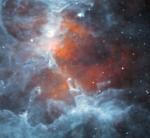 Cold Dust in the Eagle Nebula
14.09.2001
Stars are born in M16's Eagle Nebula, a stellar nursery 7,000 light-years from Earth toward the constellation Serpens. The striking nebula's star forming pillars of gas and dust are familiar to astronomers from images at visible wavelengths, but this false-color picture shows off the nebula in infrared light.
 NGC 4414: A Flocculent Spiral Galaxy
3.04.2002
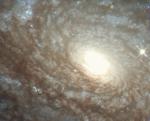
How much mass do flocculent spirals hide? The above true color image of flocculent spiral galaxy NGC 4414 was taken with the Hubble Space Telescope to help answer this question. Flocculent spirals -- galaxies without well defined spiral arms -- are a quite common form of galaxy, and NGC 4414 is one of the closest.
 NGC 6357: Stellar Wonderland
26.12.2016
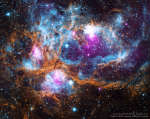
For reasons unknown, NGC 6357 is forming some of the most massive stars ever discovered. This complex wonderland of star formation consists of numerous filaments of dust and gas surrounding huge cavities of massive star clusters. The intricate patterns are caused by complex interactions between interstellar winds, radiation pressures, magnetic fields, and gravity.
|
January February March April May June July August September October |
|||||||||||||||||||||||||||||||||||||||||||||||||