
|
You entered: gravity
 NGC 6357: The Lobster Nebula
7.02.2017
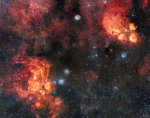
Why is the Lobster Nebula forming some of the most massive stars known? No one is yet sure. Near the more obvious Cat's Paw nebula on the upper right, the Lobster Nebula...
 Centaurus A: The Galaxy Deep Inside
4.12.1998
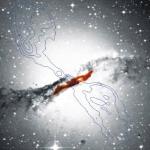
Deep inside Centaurus A, the closest active galaxy to Earth, lies ... another galaxy! Cen A is a giant elliptical galaxy a mere 10 million light-years distant with a central jumble of stars, dust, and gas that probably hides a massive black hole.
 Too Close to a Black Hole
27.11.1995
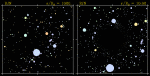
What would you see if you went right up to a black hole? Above are two computer generated pictures highlighting how strange things would look. On the left is a normal star field containing the constellation Orion. Notice the three stars of nearly equal brightness that make up Orion's Belt.
 Apollo 17 s Lunar Rover
5.06.2004
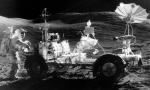
In December of 1972, Apollo 17 astronauts Eugene Cernan and Harrison Schmitt spent about 75 hours exploring the Moon's Taurus-Littrow valley while colleague Ronald Evans orbited overhead. Cernan and Schmitt were the last humans to walk or ride on the Moon - aided in their explorations by a Lunar Roving Vehicle.
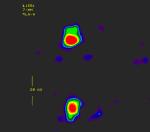 Twin Proto Planetary Disks
25.09.1998
Sun-like stars are forming - and probably planets too - hidden inside Lynds 1551, an interstellar cloud of molecular gas and dust in the constellation Taurus. Using new receivers, coordinated radio telescopes at the Very Large Array near Socorro, New Mexico, USA, can now sharply image the dusty proto-planetary disks surrounding these young stars at radio wavelengths.
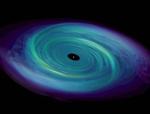 Accretion Disk Simulation
12.03.2005
Don't be fooled by the familiar pattern. The graceful spiral structure seen in this computer visualization does not portray winding spiral arms in a distant galaxy of stars. Instead, the graphic shows spiral...
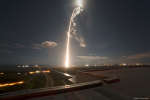 Launch of the Solar Orbiter
11.02.2020
How does weather on the Sun affect humanity? To help find out, the European Space Agency (ESA) and NASA have just launched the Solar Orbiter. This Sun-circling robotic spaceship will monitor...
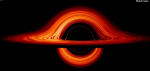 APOD: 2020 August 25 Б Visualization: A Black Hole Accretion Disk
25.08.2020
What would it look like to circle a black hole? If the black hole was surrounded by a swirling disk of glowing and accreting gas, then the great gravity of the black hole would deflect light emitted by the disk to make it look very unusual. The featured animated video gives a visualization.
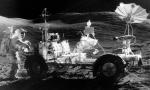 Apollo 17 s Lunar Rover
9.06.2001
In December of 1972, Apollo 17 astronauts Eugene Cernan and Harrison Schmitt spent about 75 hours exploring the Moon's Taurus-Littrow valley while colleague Ronald Evans orbited overhead. Cernan and Schmitt were the last humans to walk or ride on the Moon - aided in their explorations by a Lunar Roving Vehicle.
 Flyby Image of Saturns Sponge Moon Hyperion
3.06.2015
Why does this moon look like a sponge? To better investigate, NASA and ESA sent the Saturn-orbiting robotic spacecraft Cassini zooming past Saturn's moon Hyperion, once again, earlier this week. One of the images beamed back to Earth is featured above, raw and unprocessed.
|
January February March April May June July August September October |
|||||||||||||||||||||||||||||||||||||||||||||||||