
|
You entered: gravity
 APOD: 2024 May 8 Б Visualization: A Black Hole Accretion Disk
8.05.2024
What would it look like to circle a black hole? If the black hole was surrounded by a swirling disk of glowing and accreting gas, then the great gravity of the black hole would deflect light emitted by the disk to make it look very unusual. The featured animated video gives a visualization.
 Curiosity s Dusty Self
23.06.2018
Winds on Mars can't actually blow spacecraft over. But in the low gravity, martian winds can loft fine dust particles in planet-wide storms, like the dust storm now raging on the Red Planet.
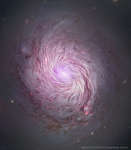 The Magnetic Fields of Spiral Galaxy M77
16.12.2019
Can magnetic fields help tell us how spiral galaxies form and evolve? To find out, the HAWC+ instrument on NASA's airborne (747) SOFIA observatory observed nearby spiral galaxy M77. HAWC+ maps magnetism by observing polarized infrared light emitted by elongated dust grains rotating in alignment with the local magnetic field.
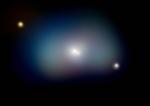 NGC 1700: Elliptical Galaxy and Rotating Disk
16.01.2003
In spiral galaxies, majestic winding arms of young stars and interstellar gas and dust rotate in a disk around a bulging galactic nucleus. Elliptical galaxies seem to be simpler, randomly swarming with old stars and lacking gas and dust.
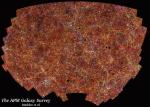 Two Million Galaxies
11.06.2003
Our universe is filled with galaxies. Galaxies -- huge conglomerations of stars, gas, dust -- and mysterious dark matter are the basic building blocks of the large-scale universe. Although distant galaxies move away from each other...
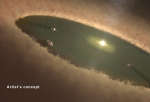 The Double Dust Disks of HD 95086
16.11.2014
What do other star systems look like? To help find out, astronomers are carrying out detailed observations of nearby stars in infrared light to see which have dust disks that might be forming planets.
 Distortion from a Distant Cluster
23.08.2001
This stunning color deep sky view toward the constellation Pisces was made with data from a fast, sensitive, digital detector known as the Big Throughput Camera operating at Cerro Tololo Inter-American Observatory in Chile.
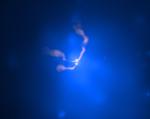 Binary Black Hole in 3C 75
12.04.2006
The two bright sources at the center of this composite x-ray (blue)/ radio (pink) image are co-orbiting supermassive black holes powering the giant radio source 3C 75. Surrounded by multimillion degree x-ray emitting gas, and blasting out jets of relativistic particles the supermassive black holes are separated by 25,000 light-years.
 APOD: 2026 March 11 Б CG 4: The Globule and the Galaxy
11.03.2026
Is this a cosmic monster ready to devour an unsuspecting galaxy? Thankfully, that is not the case. The red БmonsterБ shown in the featured image is Cometary Globule CG 4, 1,300 light-years away in the Constellation Puppis.
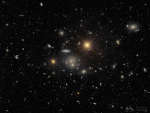 The Hydra Cluster of Galaxies
16.02.2023
Once upon a midnight dreary, while I pondered weak and weary, O'er volumes of astronomy and forgotten lore, I stumbled upon this snapshot, cosmic and eerie, A sight that filled my heart with awe and more.
|
January February March April May June July August September October |
|||||||||||||||||||||||||||||||||||||||||||||||||