
|
You entered: gravity
 Galaxy Wars: M81 and M82
15.05.2020
These two galaxies are far far away, 12 million light-years distant toward the northern constellation of the Great Bear. On the left, with grand spiral arms and bright yellow core is spiral galaxy M81, some 100,000 light-years across. On the right marked by red gas and dust clouds, is irregular galaxy M82.
 APOD: 2026 May 20 Б The Dark Wolf Nebula
20.05.2026
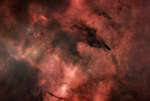
A dark wolf lies in gum. No, this isnБt a riddle! Today's image features the Dark Wolf Nebula (SandqvistБLindroos 17), a spooky dust cloud embedded within the Gum 55 (RCW 113) Nebula in the Scorpius constellation.
 Too Close to a Black Hole
8.09.2002
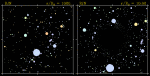
What would you see if you went right up to a black hole? Above are two computer generated images highlighting how strange things would look. On the left is a normal star field containing the constellation Orion. Notice the three stars of nearly equal brightness that make up Orion's Belt.
 Mercury: A Cratered Inferno
12.09.2004
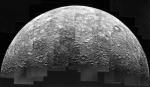
Mercury's surface looks similar to our Moon's. Each is heavily cratered and made of rock. Mercury's diameter is about 4800 km, while the Moon's is slightly less at about 3500 km (compared with about 12,700 km for the Earth). But Mercury is unique in many ways.
 Messier 5
9.05.2019
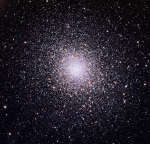
"Beautiful Nebula discovered between the Balance [Libra] & the Serpent [Serpens] ..." begins the description of the 5th entry in 18th century astronomer Charles Messier's famous catalog of nebulae and star clusters. Though it appeared...
 APOD: 2023 September 3 Б Comet Schwassmann Wachmann 3 Fragments
3.09.2023
Periodic comet 73P/Schwassmann-Wachmann 3 has broken up at least twice. A cosmic souffle of ice and dust left over from the early solar system, this comet was first seen to split into several large pieces during the close-in part of its orbit in 1995.
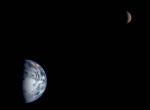 The Earth-Moon System
29.01.1998
This evocative mosaic image of the Earth-Moon system was recorded by NASA's Near Earth Asteroid Rendezvous (NEAR) spacecraft earlier this month. The relative sizes shown are appropriate for viewing both the Earth...
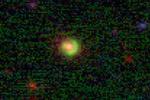 Ring Around the Galaxy
23.12.1998
It is difficult to hide one galaxy far behind another. The closer galaxy's gravity will act like a huge lens, pulling images of the background galaxy around both sides. This is just...
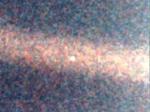 APOD: 2006 January 1- The Largest Rock in the Solar System
1.01.2006
There, that faint dot in the center - that's the largest rock known in our Solar System. It is larger than every known asteroid, moon, and comet nucleus. It is larger than any other local rocky planet.
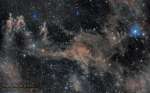 Stardust in Aries
9.12.2017
This composition in stardust covers over 8 degrees on the northern sky. The mosaicked field of view is west of the familiar Pleiades star cluster, toward the zodiacal constellation Aries and the plane of our Milky Way Galaxy.
|
January February March April May June July August September October |
|||||||||||||||||||||||||||||||||||||||||||||||||