
|
You entered: time
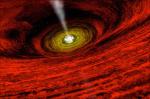 GRO J165540: Evidence for a Spinning Black Hole
26.12.2004
In the center of a swirling whirlpool of hot gas is likely a beast that has never been seen directly: a black hole. Studies of the bright light emitted by the swirling gas frequently indicate not only that a black hole is present, but also likely attributes.
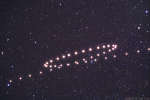 Retrograde Mars
13.06.2010
Why would Mars appear to move backwards? Most of the time, the apparent motion of Mars in Earth's sky is in one direction, slow but steady in front of the far distant stars. About every two years, however, the Earth passes Mars as they orbit around the Sun.
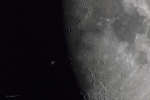 Space Station over Lunar Terminator
27.04.2015
What's that in front of the Moon? It's the International Space Station. Using precise timing, the Earth-orbiting space platform was photographed in front of a partially lit Moon last year. The featured image was taken from Madrid, Spain with an exposure time of only 1/1000 of a second.
 Julius Caesar and Leap Days
29.02.2004
Today, February 29th, is a leap day - a relatively rare occurrence. In 46 BC, Julius Caesar, pictured above in a self-decreed minted coin, created a calendar system that added one leap day every four years.
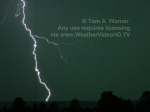 Lightning Captured at 7207 Images per Second
23.07.2012
How fast is lightning? Lightning, in fact, moves not only too fast for humans to see, but so fast that humans can't even tell which direction it is moving. The above lightning stroke did not move too fast, however, for this extremely high time resolution video to resolve.
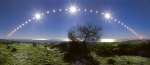 Tyrrhenian Sea and Solstice Sky
22.12.2007
Today the Solstice occurs at 0608 Universal Time, the Sun reaching its southernmost declination in planet Earth's sky. Of course, the December Solstice marks the beginning of winter in the northern hemisphere and summer in the south.
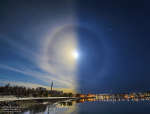 Sun and Moon Halo
3.04.2015
Two pictures captured on April 1 are combined in this creative day and night composite. Separated in time by about 10 hours the images otherwise match, looking along the coast at Östersund Sweden.
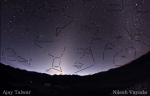 Zodiacal Light and the False Dawn
16.01.2012
Is it dawn or false dawn? During certain times of the year, the horizon near the rising Sun will begin to glow unusually early. This early glow does not originate directly from the Sun, but rather from sunlight reflected by interplanetary dust.
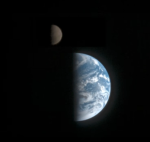 Earth and Moon
5.09.2021
The Earth and Moon are rarely photographed together. One of most spectacular times this occurred was about 30 years ago when the Jupiter-bound Galileo spacecraft zoomed past our home planetary system. Then, robotic Galileo watched from about 15-times the Earth-Moon separation as our only natural satellite glided past our home world.
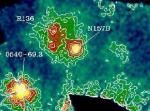 Ultra Fast Pulsar
11.02.1998
Pulsars are rotating neutron stars, born in the violent crucibles of supernova explosions. Like cosmic lighthouses, beams of radiation from surface hotspots sweep past our viewpoint creating pulses which reveal the rotation rates of these incredibly dense stellar corpses. The most famous pulsar of all is found in the nearby supernova remnant, the Crab Nebula.
|
January February March April May June July August September |
|||||||||||||||||||||||||||||||||||||||||||||||||