
|
You entered: star
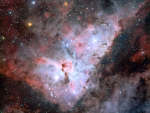 The Great Carina Nebula
16.02.2009
A jewel of the southern sky, the Great Carina Nebula, aka NGC 3372, spans over 300 light-years, one of our Galaxy's largest star forming regions. Like the smaller, more northerly Great Orion Nebula...
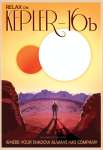 Where Your Shadow Has Company
20.02.2016
Want to take a relaxing interstellar vacation? Consider visiting Kepler-16b, a world in a binary star system. In fact Kepler-16b is the first discovered circumbinary planet. It was detected in a wide 229 day orbit around a close pair of cool, low-mass stars some 200 light-years away.
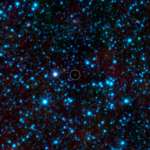 The Coldest Brown Dwarf
30.08.2011
This cosmic snapshot composed with image data from NASA's Wide-field Infrared Survey Explorer (WISE) satellite captures a multitude of faint stars and distant galaxies toward the constellation Lyra at wavelengths longer than visible light. But the object circled at the center is not quite a star.
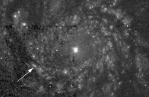 A Supernova in the Whirlpool
21.04.1996
In 1994, a new star in a distant galaxy was seen by amateur astronomers, who alerted the world to their discovery of a supernova. Near the nucleus of spiral galaxy M51, popularly known...
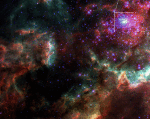 In the Center of 30 Doradus
24.05.1996
In the center of 30 Doradus lies a huge cluster of the largest, hottest, most massive stars known. The center of this cluster, known as R136, is boxed in the upper right portion of the above picture.
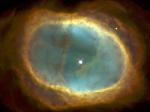 NGC 3132: The Eight Burst Nebula
13.09.2003
It's the dim star, not the bright one, near the center of NGC 3132 that created this odd but beautiful planetary nebula. Nicknamed the Eight-Burst Nebula and the Southern Ring Nebula, the glowing gas originated in the outer layers of a star like our Sun.
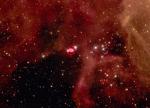 A Supernova Starfield
9.02.1999
Bright stars don't last forever. A bright star similar to others in this field exploded in a spectacular supernova that was witnessed on Earth in 1987. The result is visible even today as unusual rings and glowing gas. The above picture is a composite of recent images taken over several years.
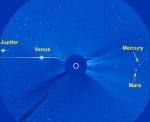 Children of the Sun
16.11.2006
For a moment, planets Jupiter, Venus, Mars, and Mercury all posed near their parent star in this Sun-centered view, recorded on November 11. The picture, from a coronograph onboard the space-based SOlar Heliospheric Observatory, spans 15 degrees with the Sun's size and position indicated by the white circle.
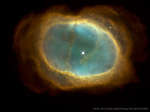 NGC 3132: The Eight Burst Nebula
7.06.2015
It's the dim star, not the bright one, near the center of NGC 3132 that created this odd but beautiful planetary nebula. Nicknamed the Eight-Burst Nebula and the Southern Ring Nebula, the glowing gas originated in the outer layers of a star like our Sun.
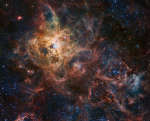 The Tarantula Zone
16.09.2022
The Tarantula Nebula, also known as 30 Doradus, is more than a thousand light-years in diameter, a giant star forming region within nearby satellite galaxy the Large Magellanic Cloud. About 180 thousand light-years away, it's the largest, most violent star forming region known in the whole Local Group of galaxies.
|
January February March April May June July August September October |
|||||||||||||||||||||||||||||||||||||||||||||||||