
|
You entered: star
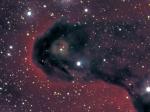 VDB 142 in Cepheus
11.10.2001
A gorgeous collection of dust and gas nebulae in the Northern Milky Way graces the high and far off constellation of Cepheus. With colors based on astronomical filters, this close up of the region highlights stars embedded in curiously shaped cosmic clouds.
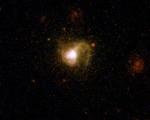 POX 186: Not So Long Ago
28.02.2004
Not so long ago and not so far, far away, a galaxy was born. Seen in this Hubble Space Telescope image, the island universe of stars, gas, and dust cataloged as POX 186 is a mere 68 million light-years distant toward an uncrowded region in the constellation Virgo.
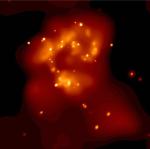 X-Rays From Antennae Galaxies
18.08.2000
A bevy of black holes and neutron stars shine as bright, point-like sources against bubbles of million degree gas in this false-color x-ray image from the orbiting Chandra Observatory. The striking picture shows...
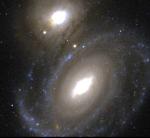 Galaxies Away
21.08.1999
This striking pair of galaxies is far, far away ... about 350 million light-years from Earth. Cataloged as AM0500-620, the pair is located in the southern constellation Dorado. The background elliptical and foreground spiral galaxy are representative of two of the three major classes of galaxies which inhabit our Universe.
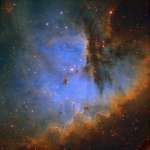 NGC 281
10.12.2008
Look through the cosmic cloud cataloged as NGC 281 and it's almost easy to miss stars of the open cluster IC 1590. But, formed within the nebula, that cluster's young, massive stars ultimately power the pervasive nebular glow.
 Gemini Observatory North
15.10.2016
It does look like a flying saucer, but this technologically advanced structure is not here to deliver the wise extraterrestrial from the scifi classic movie The Day the Earth Stood Still. It is here to advance our knowledge of the Universe though.
 Sigma Octantis and Friends
28.06.2018
South pole star Sigma Octantis (of the constellation Octans) is on the left of this starry expanse spanning over 40 degrees across far southern skies. You'll have to look hard to find it, though.
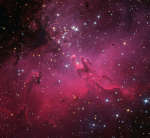 M16 and the Eagle Nebula
15.11.2019
A star cluster around 2 million years young surrounded by natal clouds of dust and glowing gas, M16 is also known as The Eagle Nebula. This beautifully detailed portrait of the region was made with groundbased narrow and broadband image data.
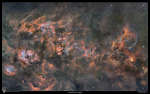 Cygnus Mosaic 2010 2020
11.02.2021
In brush strokes of interstellar dust and glowing gas, this beautiful skyscape is painted across the plane of our Milky Way Galaxy near the northern end of the Great Rift and the constellation Cygnus the Swan.
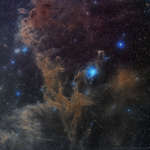 Chamaeleon Dark Nebulas
17.01.2022
Sometimes the dark dust of interstellar space has an angular elegance. Such is the case toward the far-south constellation of Chamaeleon. Normally too faint to see, dark dust is best known for blocking visible light from stars and galaxies behind it.
|
January February March April May June July August September October |
|||||||||||||||||||||||||||||||||||||||||||||||||