
|
You entered: star
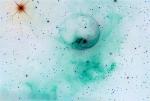 The Bubble Nebula from NOAO
17.06.2003
It's the bubble versus the cloud. NGC 7635, the Bubble Nebula, is being pushed out by the stellar wind of massive central star BD+602522. Next door, though, lives a giant molecular cloud, visible above to the lower right.
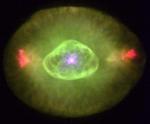 NGC 6826: The Blinking Eye
18.12.1997
The colorful planetary nebula phase of a sun-like star's life is brief. Almost in the "blink of an eye" - cosmically speaking - the star's outer layers are cast off, forming an expanding emission nebula. This nebula lasts perhaps 10 thousand years compared to a 10 billion year stellar life span.
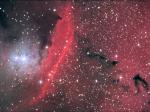 In the Center of NGC 6559
29.06.2004
Bright gas and dark dust permeate the space between stars in the center of a nebula known as NGC 6559. The gas, primarily hydrogen, is responsible for the diffuse red glow of the emission nebula.
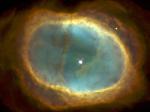 NGC 3132: The Eight Burst Nebula
5.02.2005
It's the dim star, not the bright one, near the center of NGC 3132 that created this odd but beautiful planetary nebula. Nicknamed the Eight-Burst Nebula and the Southern Ring Nebula, the glowing gas originated in the outer layers of a star like our Sun.
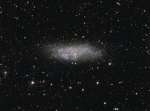 Wolf Lundmark Melotte
18.05.2017
Named for the three astronomers instrumental in its discovery and identification, Wolf - Lundmark - Melotte (WLM) is a lonely dwarf galaxy. Seen toward the mostly southern constellation Cetus, about 3 million light-years from the Milky Way, it is one of the most remote members of our local galaxy group.
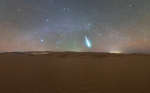 Gemind of the North
16.12.2021
An arid expanse of the Tengger Desert in north-central China, planet Earth fills the foreground of this starry scene. A widefield panoramic view, it was recorded shortly after moonset in the local predawn hours of December 14. Pictured in the still dark sky, stars of the northern winter hexagon surround a luminous Milky Way.
 The Tarantula Zone
7.03.2024
The Tarantula Nebula, also known as 30 Doradus, is more than a thousand light-years in diameter, a giant star forming region within nearby satellite galaxy the Large Magellanic Cloud. About 180 thousand light-years away, it's the largest, most violent star forming region known in the whole Local Group of galaxies.
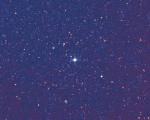 A Close Encounter of the Stellar Kind
26.06.1997
The unassuming star centered in this sky view will one day be our next door stellar neighbor. The faint 9th magnitude red dwarf currently 63 light-years away in the constellation Ophiucus was recently discovered to be on a course toward our Solar System.
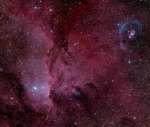 NGC 6188 and NGC 6164
28.07.2011
Fantastic shapes lurk in clouds of glowing hydrogen gas in NGC 6188. The emission nebula is found near the edge of a large molecular cloud, unseen at visible wavelengths, in the southern constellation Ara, about 4,000 light-years away.
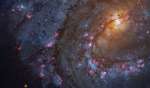 In the Arms of M83
11.11.2011
Big, bright, and beautiful, spiral galaxy M83 lies a mere twelve million light-years away, near the southeastern tip of the very long constellation Hydra. This cosmic close-up, a mosaic based on data from...
|
January February March April May June July August September October |
|||||||||||||||||||||||||||||||||||||||||||||||||