
|
You entered: planets
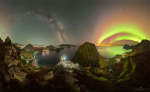 An Artful Sky over Lofoten Islands
13.12.2022
Can the night sky be both art and science? If so, perhaps the featured image is an example. The digital panorama was composed of 10 landscape and 10 sky images all taken on the same night, from the same location, and with the same camera.
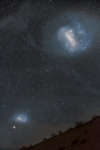 Magellanic Clouds over Chile
11.02.2023
The two prominent clouds in this Chilean Atacama Desert skyscape captured on January 21 actually lie beyond our Milky Way galaxy. Known as the Large and the Small Magellanic Clouds they are so named for the 16th century Portuguese explorer Ferdinand Magellan, leader of the first circumnavigation of planet Earth.
 Comet C 2023 E1 ATLAS near Perihelion
14.07.2023
Comet C/2023 E1 (ATLAS) was just spotted in March, another comet found by the NASA funded Asteroid Terrestrial-impact Last Alert System. On July 1 this Comet ATLAS reached perihelion, its closest approach to the Sun.
 Tycho Brahe Measures the Sky
15.09.1996
Tycho Brahe was the most meticulous astronomical observer of his time. Brahe, who lived between 1546 and 1601, set out to solve the day's most pressing astronomical problem: to determine whether the Earth or the Sun was at the center of the Solar System.
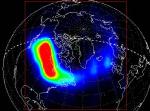 Solar Storm Causes X-Ray Aurora
18.04.1997
On April 7, the SOHO spacecraft spotted a Solar Storm ejecting a cloud of energetic particles toward planet Earth. The plasma cloud's center missed Earth, but high energy particles swept up by Earth's magnetosphere still created a geomagnetic storm!
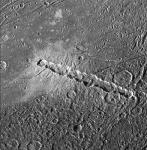 Ganymede: Torn Comet Crater Chain
5.08.1998
This remarkable line of 13 closely spaced craters on Jupiter's moon Ganymede was photographed by the Galileo spacecraft in 1997. The picture covers an area about 120 miles wide and the chain of craters cuts across a sharp boundary between dark and light terrain. What caused this crater chain?
 Tycho Brahe Measures the Sky
30.05.1999
Tycho Brahe was the most meticulous astronomical observer of his time. Brahe, who lived between 1546 and 1601, set out to solve the day's most pressing astronomical problem: to determine whether the Earth or the Sun was at the center of the Solar System.
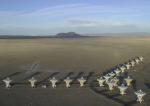 The Very Large Array of Radio Telescopes
14.05.2006
The most photogenic array of radio telescopes in the world has also been one of the most productive. Each of the 27 radio telescopes in the Very Large Array (VLA) is the size of a house and can be moved on train tracks.
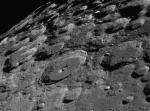 Southern Moonscape
23.08.2007
The Moon's south pole is near the top of this sharp telescopic view looking across the southern lunar highlands. Recorded on August 3rd from Tecumseh, Oklahoma, planet Earth, the foreshortened perspective heightens the impression of a dense field of craters and makes the craters themselves appear more oval shaped.
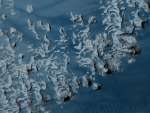 Layers in Aureum Chaos
4.04.2008
At first glance these undulating shapes in shades of blue might look like waves on an ocean. Seen here in a false-color image from the Mars Reconnaissance Orbiter's HiRISE camera, they are actually layered rock outcrops found in Aureum Chaos.
|
January February March April May June July August September October |
|||||||||||||||||||||||||||||||||||||||||||||||||