
|
You entered: dark
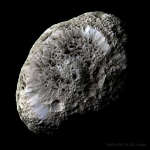 APOD: 2023 March 12 Б Saturns Hyperion: A Moon with Odd Craters
12.03.2023
What lies at the bottom of Hyperion's strange craters? To help find out, the robot Cassini spacecraft that once orbited Saturn swooped past the sponge-textured moon and took images of unprecedented detail.
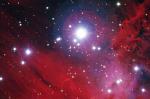 NGC 2264: Stars, Dust, and Gas
24.04.2001
The nebula surrounding bright star S Mon is filled with dark dust and glowing gas. The strange shapes that haunt this star forming region originate from fine interstellar dust reacting in complex ways to the energetic light and hot gas being expelled by the young stars.
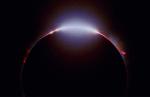 Madagascar Totality
26.07.2001
When the Moon's shadow reached out and touched Earth's southern hemisphere on 2001 June 21, the first total solar eclipse of the 21st century began. Starting in the Atlantic, the dark, central...
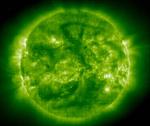 S is for Sun
21.03.2002
Taken yesterday from the SOHO spacecraft, this false-color image shows the active Sun near the March Equinox, the beginning of Fall in the south and Spring in the northern hemisphere. Recorded in a band...
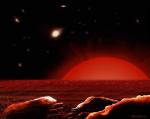 Stars Without Galaxies
15.02.1998
Galaxies are made up of stars, but are all stars found within galaxies? Using the Hubble Space Telescope, researchers exploring the Virgo Cluster of galaxies have now found about 600 red giant stars adrift in intergalactic space. Above is an artist's vision of the sky from a hypothetical planet of such a lonely sun.
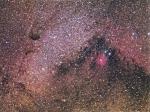 M24: A Sagittarius Starscape
21.09.2004
Many vast star fields in the plane of our Milky Way Galaxy are rich in clouds of dust, and gas. First and foremost, visible in the above picture are millions of stars, many of which are similar to our Sun.
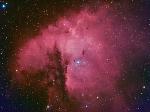 NGC 281: Cluster, Clouds, and Globules
20.10.2004
NGC 281 is a busy workshop of star formation. Prominent features include a small open cluster of stars, a diffuse red-glowing emission nebula, large lanes of obscuring gas and dust, and dense knots of dust and gas in which stars may still be forming.
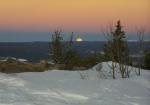 Shadow Set
27.01.2005
A nearly full Moon and planet Earth's shadow set together in this scene captured Monday from snowy Mt. Jelm, home of the Wyoming Infrared Observatory. For early morning risers (and late...
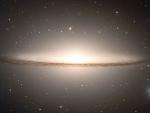 The Sombrero Galaxy from VLT
28.02.2000
Why does the Sombrero Galaxy look like a hat? Reasons include the Sombrero's unusually large and extended central bulge of stars, and dark prominent dust lanes that appear in a disk that we see nearly edge-on. Billions of old stars cause the diffuse glow of the extended central bulge.
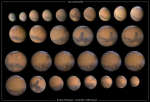 Changes in Angular Mars
14.07.2008
Does Mars always appear the same? No. As both Earth and Mars orbit the Sun, the apparent angular size of Mars changes as viewed from the Earth. Pictured above from Enschede, Holland, Mars was captured in 2007 and 2008 with 30 separate images, all taken with the same magnification.
|
January February March April May June July August September |
|||||||||||||||||||||||||||||||||||||||||||||||||