
|
You entered: dark
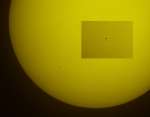 Atlantis and Hubble Side by Side
16.05.2009
On Wednesday, May 13, two, tiny, fast moving spots crossed an otherwise featureless solar disk. Not sunspots though, the dark blemishes were silhouettes of the shuttle orbiter Atlantis and the Hubble Space Telescope side by side.
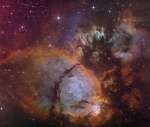 The Colors of IC 1795
10.12.2009
This colorful cosmic portrait features glowing gas and dark dust clouds in IC 1795, a star forming region in the northern constellation Cassiopeia. The nebula's colors were created by adopting the Hubble false-color...
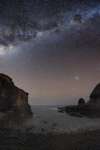 The Milky Way Over Pulpit Rock
5.07.2010
Can a picture of the sky be relaxing? A candidate for such a picture might be the above image taken only last month from Cape Schank, Victoria, Australia. The frame is highlighted by a quiet lagoon, soft ground fog, two galaxies, and tens of thousands of stars.
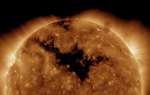 Hole in the Sun
28.08.2010
This ominous, dark shape sprawling across the face of the Sun is a coronal hole -- a low density region extending above the surface where the solar magnetic field opens freely into interplanetary space. Studied...
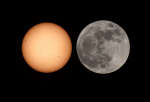 Sun vs Super Moon
11.05.2012
The Super Moon wins, by just a little, when its apparent size is compared to the Sun in this ingenious composite picture. To make it, the Full Moon on May 6 was photographed with the same camera and telescope used to image the Sun (with a dense solar filter!) on the following day.
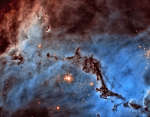 N11: Star Clouds of the LMC
11.02.2013
Massive stars, abrasive winds, mountains of dust, and energetic light sculpt one of the largest and most picturesque regions of star formation in the Local Group of Galaxies. Known as N11, the region...
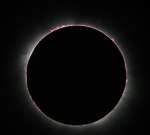 Solar Eclipse from Uganda
8.11.2013
The Sun's disk was totally eclipsed for a brief 20 seconds as the Moon's dark umbral shadow raced across Pokwero in northwestern Uganda on November 3rd. So this sharp telescopic view of totality in clear skies from the central African locale was much sought after by eclipse watchers.
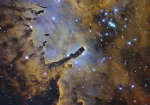 NGC 6823: Cloud Sculpting Star Cluster
8.10.2014
Star cluster NGC 6823 is slowly turning gas clouds into stars. The center of the open cluster, visible on the upper right, formed only about two million years ago and is dominated in brightness by a host of bright young blue stars.
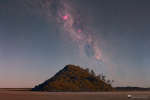 Carina over Lake Ballard
5.01.2018
A jewel of the southern sky, the Great Carina Nebula, also known as NGC 3372, is one of our galaxy's largest star forming regions. Easily visible to the unaided eye it stands high...
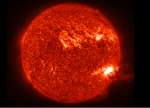 The Sun Unleashed: Monster Filament in Ultraviolet
9.04.2018
One of the most spectacular solar sights is an explosive flare. In 2011 June, the Sun unleashed somewhat impressive, medium-sized solar flare as rotation carried active regions of sunpots toward the solar limb. That...
|
January February March April May June July August September |
|||||||||||||||||||||||||||||||||||||||||||||||||