
|
You entered: space
 APOD: 2006 January 1- The Largest Rock in the Solar System
1.01.2006
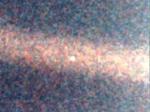
There, that faint dot in the center - that's the largest rock known in our Solar System. It is larger than every known asteroid, moon, and comet nucleus. It is larger than any other local rocky planet.
 NGC 3314: When Galaxies Overlap
11.05.2000
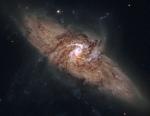
Can this be a spiral galaxy? In fact, NGC 3314 consists of two large spiral galaxies which just happen to almost exactly line-up. The foreground spiral is viewed nearly face-on, its pinwheel shape defined by young bright star clusters.
 A Giant Gouge on Asteroid Eros
21.02.2000
Asteroid 433 Eros is posing several riddles. NASA's robot spacecraft NEAR began orbiting the 30-kilometer space rock last week, and new pictures are now being beamed back to Earth regularly. As usual in science, when you arrive at a place you've never been before, you see things you don't immediately understand.
 Teimareh Petroglyphs and Star Trails
12.07.2012
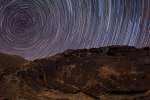
Engraved in rock, these ancient petroglyphs are abundant in the Teimareh valley, located in the Zagros Mountains of central Iran. They likely tell a tale of hunters and animals found in the middle eastern valley 6,000 years ago or more, etched by artists in a prehistoric age.
 The Red Spider Planetary Nebula
29.10.2012
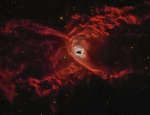
Oh what a tangled web a planetary nebula can weave. The Red Spider Planetary Nebula shows the complex structure that can result when a normal star ejects its outer gases and becomes a white dwarf star.
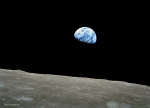 Earthrise
6.09.2015
What's that rising over the edge of the Moon? Earth. About 47 years ago, in December of 1968, the Apollo 8 crew flew from the Earth to the Moon and back again. Frank...
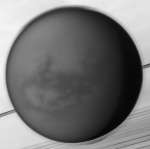 Titan: Moon over Saturn
26.05.2018
Like Earth's moon, Saturn's largest moon Titan is locked in synchronous rotation. This mosiac of images recorded by the Cassini spacecraft in May of 2012 show's its anti-Saturn side, the side always facing away from the ringed gas giant.
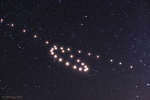 Mars in the Loop
8.11.2018
This composite of images spaced some 5 to 9 days apart, from late April (bottom right) through November 5 (top left), traces the retrograde motion of ruddy-colored Mars through planet Earth's night sky.
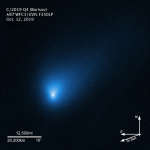 Interstellar Interloper 2I Borisov
18.10.2019
After the 2017 detecton of 1I/'Oumuamua, comet 2I/Borisov has become the second recognized interstellar interloper. Like 'Oumuamua, Borisov's measured hyperbolic trajectory and speed as it falls toward the Sun confirm that its origin is from beyond our Solar System.
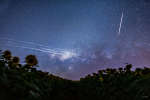 Starlink Satellite Trails over Brazil
10.12.2019
What are those streaks over the horizon? New Starlink satellites reflecting sunlight. SpaceX launched 60 Starlink communication satellites in May and 60 more in November. These satellites and thousands more are planned by communications companies in the next few years that may make streaks like these relatively common.
|
January February March April May June July August September October |
|||||||||||||||||||||||||||||||||||||||||||||||||