
|
You entered: space
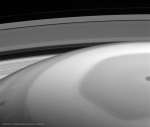 Cassini Looks Out from Saturn
23.12.2022
This is what Saturn looks like from inside the rings. In 2017, for the first time, NASA directed the Cassini spacecraft to swoop between Saturn and its rings. During the dive, the robotic spacecraft took hundreds of images showing unprecedented detail for structures in Saturn's atmosphere.
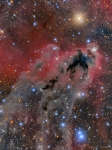 APOD: 2023 January 25 Б LDN 1622: The Boogeyman Nebula
25.01.2023
To some, the dark shape looks like a mythical boogeyman. Scientifically, Lynds' Dark Nebula (LDN) 1622 appears against a faint background of glowing hydrogen gas only visible in long telescopic exposures of the region.
 Runaway Star Alpha Camelopardalis
28.04.2023
Like a ship plowing through cosmic seas, runaway star Alpha Camelopardalis has produced this graceful arcing bow wave or bow shock. The massive supergiant star moves at over 60 kilometers per second through space, compressing the interstellar material in its path.
 APOD: 2023 May 7 Б The Helix Nebula from CFHT
7.05.2023
Will our Sun look like this one day? The Helix Nebula is one of brightest and closest examples of a planetary nebula, a gas cloud created at the end of the life of a Sun-like star.
 APOD: 2023 December 11 Б Solar Minimum versus Solar Maximum
11.12.2023
The surface of our Sun is constantly changing. Some years it is quiet, showing relatively few sunspots and active regions. Other years it is churning, showing many sunspots and throwing frequent Coronal Mass Ejections (CMEs) and flares.
 Northern Lights from the Stratosphere
18.01.2024
Northern lights shine in this night skyview from planet Earth's stratosphere, captured on January 15. The single, 5 second exposure was made with a hand-held camera on board an aircraft above Winnipeg, Canada. During the exposure, terrestrial lights below leave colorful trails along the direction of motion of the speeding aircraft.
 APOD: 2024 October 30 Б NGC 7635: The Bubble Nebula
30.10.2024
What created this huge space bubble? Blown by the wind from a star, this tantalizing, head-like apparition is cataloged as NGC 7635, but known simply as the Bubble Nebula. The featured striking view utilizes a long exposure to reveal the intricate details of this cosmic bubble and its environment.
 APOD: 2025 January 6 Б Colliding Spiral Galaxies from Webb and Hubble
6.01.2025
Billions of years from now, only one of these two galaxies will remain. Until then, spiral galaxies NGC 2207 and IC 2163 will slowly pull each other apart, creating tides of matter, sheets of shocked gas, lanes of dark dust, bursts of star formation, and streams of cast-away stars.
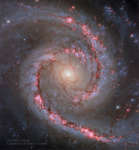 APOD: 2026 March 16 Б NGC 1566: The Spanish Dancer Galaxy
16.03.2026
If not perfect, then this spiral galaxy is at least one of the most photogenic. An island universe containing billions of stars and situated about 40 million light-years away toward the constellation of the Dolphinfish (Dorado), NGC 1566 presents a gorgeous face-on view.
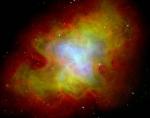 The Crab Nebula Pulsar Shrugs
20.09.2002
How does a city-sized neutron star power the vast Crab Nebula? The expulsion of wisps of hot gas at high speeds appears to be at least part of the answer. Yesterday time-lapse movies taken...
|
January February March April May June July August September October |
|||||||||||||||||||||||||||||||||||||||||||||||||