
|
You entered: Earth
 The Great Meteor Procession of 1913
9.02.2013
One hundred years ago today the Great Meteor Procession of 1913 occurred, a sky event described by some as "magnificent" and "entrancing" and which left people feeling "spellbound" and "privileged". Because one had to be in a right location, outside, and under clear skies, only about 1,000 people noted seeing the procession.
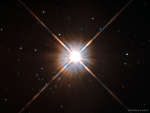 Proxima Centauri: The Closest Star
18.01.2016
Does the closest star to our Sun have planets? No one is sure -- but you can now follow frequent updates of a new search that is taking place during the first few months of this year. The closest star, Proxima Centauri, is the nearest member of the Alpha Centauri star system.
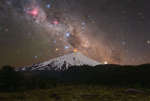 Southern Cross over Chilean Volcano
25.01.2021
Have you ever seen the Southern Cross? This famous four-star icon is best seen from Earth's Southern Hemisphere. The featured image was taken last month in Chile and captures the Southern Cross just to the left of erupting Villarrica, one of the most active volcanos in our Solar System.
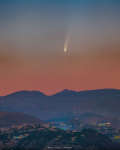 Comet NEOWISE over Lebanon
7.07.2020
A comet has suddenly become visible to the unaided eye. Comet C/2020 F3 (NEOWISE) was discovered in late March and brightened as it reached its closest approach to the Sun, inside the orbit of Mercury, late last week.
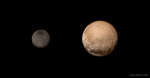 New Horizons Passes Pluto and Charon
14.07.2015
Will the New Horizons spacecraft survive its closest approach to Pluto and return useful images and data? Humanity will know in a few hours. Regardless of how well it functions, New Horizon's rapid...
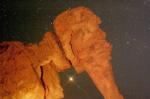 Mars Rising Behind Elephant Rock
28.08.2003
Yesterday, at about 10 am Universal Time, Mars and Earth passed closer than in nearly 60,000 years. Mars, noticeably red, remains the brightest object in the eastern sky just after sunset. The best...
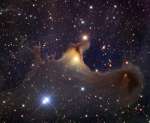 Ghost of the Cepheus Flare
31.10.2011
Spooky shapes seem to haunt this starry expanse, drifting through the night in the royal constellation Cepheus. Of course, the shapes are cosmic dust clouds faintly visible in dimly reflected starlight. Far from your...
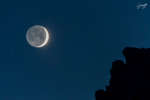 The Bull s Eye and the Young Moon
5.05.2017
Aldebaran, eye of Taurus the Bull, and a young crescent Moon shared an early evening sky last Friday. The lovely celestial pairing could be enjoyed around planet Earth, but from some locations the Moon was even seen to pass in front of Aldebaran, a dramatic lunar occultation of the familiar bright star.
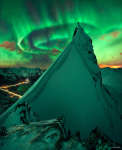 APOD: 2023 January 22 Б In Green Company: Aurora over Norway
22.01.2023
Raise your arms if you see an aurora. With those instructions, two nights went by with, well, clouds -- mostly. On the third night of returning to same peaks, though, the sky not only cleared up but lit up with a spectacular auroral display.
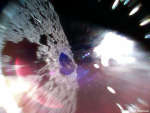 Rover 1A Hops on Asteroid Ryugu
24.09.2018
Two small robots have begun hopping around the surface of asteroid Ryugu. The rovers, each the size of a small frying pan, move around the low gravity of kilometer-sized 162173 Ryugu by hopping, staying aloft for about 15 minutes and typically landing again several meters away.
|
January February March April May June July August September October |
|||||||||||||||||||||||||||||||||||||||||||||||||