
|
You entered: Earth
 Pandora's Cluster of Galaxies
8.06.2024
This deep field mosaicked image presents a stunning view of galaxy cluster Abell 2744 recorded by the James Webb Space Telescope's NIRCam. Also dubbed Pandora's Cluster, Abell 2744 itself appears to be a ponderous merger of three different massive galaxy clusters. It lies some 3.5 billion light-years away, toward the constellation Sculptor.
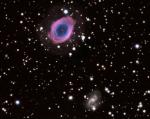 A Tale of Two Nebulae
16.05.2003
This colorful telescopic view towards the northern constellation Lyra reveals dim outer regions around M57, popularly known as the Ring Nebula. While modern astronomers still refer to M57 as a planetary nebula, at one light-year across M57 is not a planet but the gaseous shroud of a dying sun-like star.
 APOD: 2023 March 21 Б Dark Nebulae and Star Formation in Taurus
21.03.2023
Can dust be beautiful? Yes, and it can also be useful. The Taurus molecular cloud has several bright stars, but it is the dark dust that really draws attention. The pervasive dust has waves...
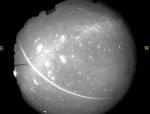 A 2001 Leonids Meteor Shower Fireball
19.11.2001
The 2001 Leonids Meteor Shower gave quite a show to many parts of the world yesterday during the early morning hours. Many sleepy observers venturing into their own backyards were treated to several bright meteors per minute streaking across the sky.
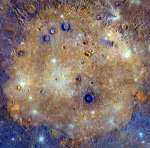 Enhanced Color Caloris
4.03.2015
The sprawling Caloris basin on Mercury is one of the solar system's largest impact basins, created during the early history of the solar system by the impact of a large asteroid-sized body.
 APOD: 2025 August 14 Б M13: The Great Globular Cluster in Hercules
14.08.2025
In 1716, English astronomer Edmond Halley noted, "This is but a little Patch, but it shews itself to the naked Eye, when the Sky is serene and the Moon absent." Of course...
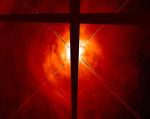 AB Aurigae: How To Make Planets
8.02.2003
This enhanced Hubble Space Telescope image shows in remarkable detail the inner portion of the disk of dust and gas surrounding the star AB Aurigae. Knots of material, visible here for the first time...
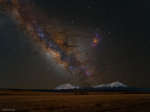 Milky Way Over the Spanish Peaks
24.05.2016
That's not lightning, and it did not strike between those mountains. The diagonal band is actually the central band of our Milky Way Galaxy, while the twin peaks are actually called the Spanish Peaks -- but located in Colorado, USA.
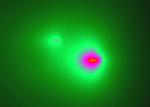 Another Comet LINEAR Breaks Up
21.05.2001
Last year, a different comet LINEAR (C/1999 S4) broke up. This year, a comet first imaged by the Lincoln Near Asteroid Research (LINEAR) telescope in New Mexico on 2001 January 3, is also breaking up.
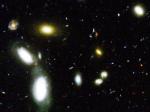 Galaxies in the GOODS
25.06.2003
This tantalizing view of galaxies scattered near and far is part of the Hubble Space Telescope's contribution to the GOODS - the Great Observatories Origins Deep Survey project. The GOODS' goal is to study...
|
January February March April May June July August September October |
|||||||||||||||||||||||||||||||||||||||||||||||||