
|
You entered: Earth
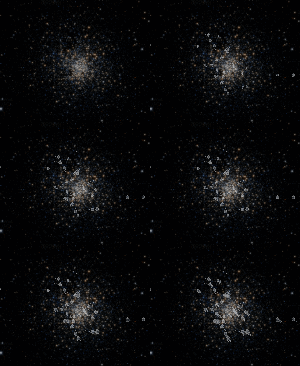 The Gaia Stars of M15
28.03.2019
Messier 15 is a 13 billion year old relic of the early formative years of our galaxy, one of about 170 globular star clusters that still roam the halo of the Milky Way. About 200 light-years in diameter, it lies about 35,000 light years away toward the constellation Pegasus.
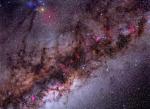 Our Galaxy in Stars, Gas, and Dust
28.09.2003
The disk of our Milky Way Galaxy is home to hot nebulae, cold dust, and billions of stars. The red nebulae visible in the above contrast-enhanced picture are primarily emission nebulae, glowing clouds of hydrogen gas heated by nearby, bright, young stars.
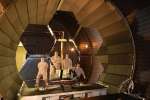 JWST: Mirrors and Masked Men
12.03.2010
Who are these masked men? Technicians from Ball Aerospace and NASA at Marshall Space Flight Center's X-ray and Cryogenic Facility, of course, testing primary mirror segments of the James Webb Space Telescope (JWST).
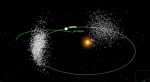 The Case of the Backwards Orbiting Asteroid
30.05.2018
Why does asteroid 2015 BZ509 orbit the Sun the backwards? As shown in the featured animation, Jupiter's trojan asteroids orbit the Sun in two major groups -- one just ahead of Jupiter, and one just behind -- but all orbit the Sun in the same direction as Jupiter.
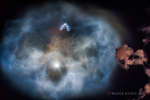 The Falcon 9 Nebula
12.10.2018
Not the Hubble Space Telescope's latest view of a distant planetary nebula, this illuminated cloud of gas and dust dazzled even casual U.S. west coast skygazers on October 7. Taken about three miles...
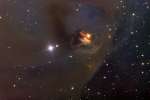 T Tauri and Hind s Variable Nebula
26.03.2011
The yellowish star near center in this remarkable telescopic skyview is T Tauri, prototype of the class of T Tauri variable stars. Nearby it is a dusty yellow cosmic cloud historically known as Hind's Variable Nebula (NGC 1555).
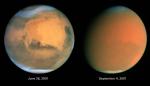 Mars Engulfed
17.10.2001
For months now, Mars has been engulfed by a great dust storm, the biggest seen raging across the Red Planet in decades. As a result, these two Hubble Space Telescope storm watch images from late June and early September offer dramatically contrasting views of the martian surface.
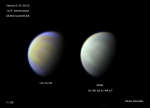 Multicolor Venus
1.03.2012
Brilliant Venus now shines in western skies at twilight. Seen as the prominent evening star, the planet is a tantalizing celestial beacon even for casual skygazers. Venus can offer less than satisfying telescopic views though. The planet is shrouded in reflective clouds that appear bright but featureless at the eyepiece.
 T Tauri and Hind s Variable Nebula
3.05.2014
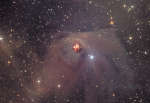
The yellowish star near center in this dusty telescopic skyview is T Tauri, prototype of the class of T Tauri variable stars. Just next door is the yellow cosmic cloud historically known as Hind's Variable Nebula (NGC 1555).
 Phobos: Doomed Moon of Mars
22.11.2015
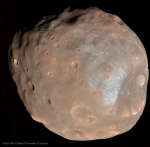
This moon is doomed. Mars, the red planet named for the Roman god of war, has two tiny moons, Phobos and Deimos, whose names are derived from the Greek for Fear and Panic. These...
|
January February March April May June July August September October |
|||||||||||||||||||||||||||||||||||||||||||||||||