
|
You entered: Earth
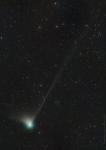 Comet 2022 E3 ZTF
24.12.2022
Comet C/2022 E3 (ZTF) was discovered by astronomers using the wide-field survey camera at the Zwicky Transient Facility this year in early March. Since then the new long-period comet has brightened substantially and is now sweeping across the northern constellation Corona Borealis in predawn skies.
 At first he couldn t see the Moon
11.04.2008
At first, he couldn't see it, but searching with binoculars along a cloudy western horizon near sunset, photographer Laurent Laveder finally spotted a delicate lunar crescent. Captured in this dramatic picture on April 6th from Bretagne, France, the Moon was only 15 hours and 38 minutes old.
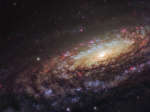 NGC 7331 Close Up
22.09.2022
Big, beautiful spiral galaxy NGC 7331 is often touted as an analog to our own Milky Way. About 50 million light-years distant in the northern constellation Pegasus, NGC 7331 was recognized early on as a spiral nebula and is actually one of the brighter galaxies not included in Charles Messier's famous 18th century catalog.
 Is Mystery Object an Orphan Afterglow
12.11.2001
What is that unusual object? Astronomers can identify most objects that are imaged on the sky, but not all. Pictured above is one that currently defies classification. Attributes of the object include that it has unusual colors, appears to be fading as months go by, and appears to be associated with a distant galaxy.
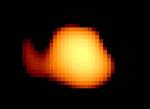 Resolving Mira
11.10.1998
Most stars appear only as points of light. Early last year, Betelgeuse became the second star, after our Sun, to have it surface resolved. Later last year, Mira was added to the list. Mira...
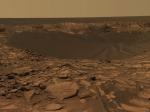 Beagle Crater on Mars
19.09.2006
What have we found on the way to large Victoria Crater? Smaller Beagle Crater. The robotic Opportunity rover rolling across Mars stopped at Beagle Crater early last month and took an impressively detailed 360-degree panorama of the alien Martian landscape. Beagle crater appears in the center as a dip exposing relatively dark sand.
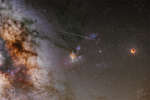 A Deep Sky Behind an Eclipsed Moon
24.05.2022
The plan was to capture a picturesque part of the sky that was hosting an unusual guest. The result included a bonus Б an additional and unexpected guest. The beautiful background features part...
 M15: Dense Globular Star Cluster
15.06.2023
Messier 15 is an immense swarm of over 100,000 stars. A 13 billion year old relic of the early formative years of our galaxy it's one of about 170 globular star clusters that still roam the halo of the Milky Way.
 Along the Taurus Molecular Cloud
23.11.2023
The cosmic brush of star formation composed this interstellar canvas of emission, dust, and dark nebulae. A 5 degree wide telescopic mosaic, it frames a region found north of bright star Aldebaran on the sky, at an inner wall of the local bubble along the Taurus molecular cloud.
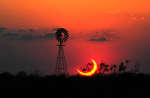 A Partial Solar Eclipse over Texas
22.05.2012
It was a typical Texas sunset except that most of the Sun was missing. The location of the missing piece of the Sun was not a mystery -- it was behind the Moon. Sunday night's partial eclipse of the Sun by the Moon turned into one of the best photographed astronomical events in history.
|
January February March April May June July August September October |
|||||||||||||||||||||||||||||||||||||||||||||||||