
|
You entered: galaxies
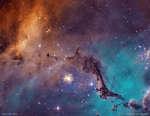 N11: Star Clouds of the LMC
12.04.2022
Massive stars, abrasive winds, mountains of dust, and energetic light sculpt one of the largest and most picturesque regions of star formation in the Local Group of Galaxies. Known as N11, the region...
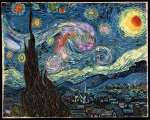 Starry Night Scavenger Hunt
15.06.2010
Did you know that Van Gogh's painting Starry Night includes Comet Hale-Bopp? Hopefully not, because it doesn't. But the above image does. Although today's featured picture may appear at first glance...
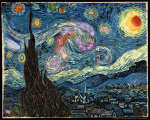 Starry Night Scavenger Hunt
18.09.2016
Did you know that van Gogh's painting Starry Night includes Comet Hale-Bopp? Hopefully not, because it doesn't. But the featured image does. Although today's picture may appear at first glance...
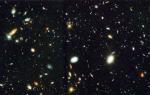 The Hubble Ultra Deep Field
9.03.2004
The above picture will be replaced later today (between 9 and 10 am EST) by the newly released Hubble Ultra Deep Field (HUDF). The HUDF is expected to be the deepest image of the universe ever taken in visible light.
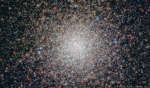 Star Cluster NGC 362 from Hubble
11.10.2017
If our Sun were near the center of NGC 362, the night sky would glow like a jewel box of bright stars. Hundreds of stars would glow brighter than Sirius, and in many different colors.
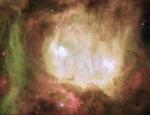 Halloween and the Ghost Head Nebula
31.10.2004
Halloween's origin is ancient and astronomical. Since the fifth century BC, Halloween has been celebrated as a cross-quarter day, a day halfway between an equinox (equal day / equal night) and a solstice (minimum day / maximum night in the northern hemisphere). With our modern calendar, however, the real cross-quarter day will occur next week.
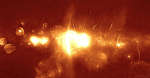 The Galactic Center in Radio from MeerKAT
8.07.2019
What's happening at the center of our galaxy? It's hard to tell with optical telescopes since visible light is blocked by intervening interstellar dust. In other bands of light, though, such as radio, the galactic center can be imaged and shows itself to be quite an interesting and active place.
 Halloween and the Ghost Head Nebula
31.10.2010
Halloween's origin is ancient and astronomical. Since the fifth century BC, Halloween has been celebrated as a cross-quarter day, a day halfway between an equinox (equal day / equal night) and a solstice (minimum day / maximum night in the northern hemisphere). With a modern calendar, however, the real cross-quarter day will occur next week.
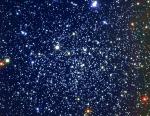 NGC 6791: An Old, Large Open Cluster
12.01.2000
NGC 6791 is one of the oldest and largest open clusters of stars known. But how did it get so dirty? Open star clusters usually contain a few hundred stars each less than a billion years old.
 APOD: 2024 August 4 Б Gaia: Here Comes the Sun
4.08.2024
What would it look like to return home from outside our galaxy? Although designed to answer greater questions, data from ESA's robotic Gaia mission is helping to provide a uniquely modern perspective on humanity's place in the universe.
|
January February March April May June July August September October |
|||||||||||||||||||||||||||||||||||||||||||||||||