
|
You entered: galaxies
 Stars and Planets over Portugal
18.04.2022
The mission was to document night-flying birds -- but it ended up also documenting a beautiful sky. The featured wide-angle mosaic was taken over the steppe golden fields in Mцrtola, Portugal in 2020. From such a dark location, an immediately-evident breathtaking glow arched over the night sky: the central band of our Milky Way galaxy.
 Exploring The Universe With IUE (1978-1996)
30.09.1996
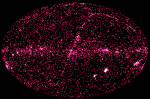
How do planets, stars, and galaxies form? How do they evolve? The International Ultraviolet Explorer (IUE) satellite was launched in 1978 and operated by NASA/ ESA/ PPARC to help provide answers to some of the most fundamental questions about the contents of our universe.
 Chandra Deep Field
28.03.2001
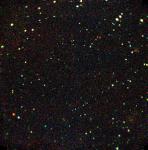
Officially the Chandra Deep Field - South, this picture represents the deepest ever x-ray image of the Universe. One million seconds of accumulated exposure time with the orbiting Chandra X-ray Observatory went in to its making.
 Stars and Lightning Over Greece
3.07.2013
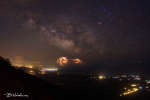
It may appear, at first, like the Galaxy is producing the lightning, but really it's the Earth. In the foreground of the above picturesque nighttime landscape is the Greek Island of Corfu, with town lights surrounding Lake Korrision. Visible farther in the distance are lights from the town of Preveza on the Greek mainland.
 Red Aurora Over Australia
29.01.2017
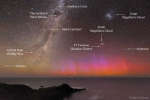
Why would the sky glow red? Aurora. A solar storm in 2012, emanating mostly from active sunspot region 1402, showered particles on the Earth that excited oxygen atoms high in the Earth's atmosphere. As the excited element's electrons fell back to their ground state, they emitted a red glow.
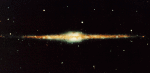 The Milky Way's Center
8.09.1995
NASA's COBE satellite scanned the heavens at infrared wavelengths in 1990 and produced this premier view of the central region of our own Milky Way Galaxy. The Milky Way is a typical spiral galaxy with a central bulge and extended disk of stars.
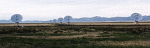 A Very Large Array of Radio Telescopes
21.06.1996
Pictured above is one of the world's premiere radio astronomical observatories: The Very Large Array (VLA). Each antenna dish is as big as a house (25 meters across) and mounted on railroad tracks. The VLA consists of 27 dishes - together capable of spanning the size of a city (35 kilometers).
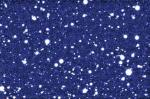 The Backyard Universe
14.04.1999
How far can you see from your own backyard? Across the Solar System, even across our Galaxy, these sights are not difficult. Recently, however, amateur Paul Boltwood gazed across the universe. His record setting image is shown above in false color.
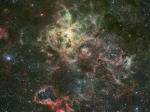 Tentacles of the Tarantula Nebula
22.08.2007
The largest, most violent star forming region known in the whole Local Group of galaxies lays in our neighboring galaxy the Large Magellanic Cloud (LMC). Were the Tarantula Nebula at the distance of the Orion Nebula -- a local star forming region -- it would take up fully half the sky.
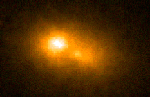 The Double Nucleus of M31
11.10.1996
The center of M31 is twice as unusual as previously thought. In 1991 the Planetary Camera then onboard the Hubble Space Telescope pointed toward the center of our Milky Way's closest major galactic neighbor: Andromeda (M31). To everyone's surprise, M31's nucleus showed a double structure.
|
January February March April May June July August September October |
|||||||||||||||||||||||||||||||||||||||||||||||||