
|
You entered: galaxies
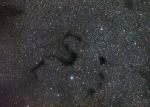 Snake in the Dark
21.05.2005
Dark nebulae snake across a gorgeous expanse of stars in this wide-field view toward the pronounceable constellation Ophiucus and the center of our Milky Way Galaxy. In fact, the central S-shape seen here is well known as the Snake Nebula.
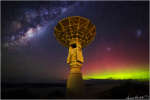 Satellite Station and Southern Skies
31.05.2014
This clear night skyscape captures the colorful glow of aurora australis, the southern lights, just outside the port city of Hobart, Tasmania, Australia, planet Earth. As if staring into the dreamlike scene, the Tasmanian Earth Resources Satellite Station poses in the center, illuminated by nearby city lights.
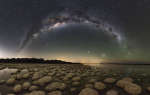 Ancients of Sea and Sky
19.06.2018
They may look like round rocks, but they're alive. Moreover, they are modern versions of one of the oldest known forms of life: stromatolites. Fossils indicate that stromatolites appeared on Earth about 3.7 billion years ago -- even before many of the familiar stars in the modern night sky were formed.
 Messier 24: Sagittarius Star Cloud
28.06.2023
Unlike most entries in Charles Messier's famous catalog of deep sky objects, M24 is not a bright galaxy, star cluster, or nebula. It's a gap in nearby, obscuring interstellar dust clouds that allows a view of the distant stars in the Sagittarius spiral arm of our Milky Way galaxy.
 APOD: 2024 May 29 Б Stairway to the Milky Way
29.05.2024
What happens if you ascend this stairway to the Milky Way? Before answering that, let's understand the beautiful sky you will see. Most eye-catching is the grand arch of the Milky Way Galaxy...
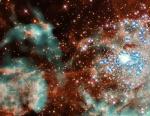 Star Cluster R136 Bursts Out
30.07.2001
In the center of star-forming region 30 Doradus lies a huge cluster of the largest, hottest, most massive stars known. Known as R136, the cluster's energetic stars are breaking out of the cocoon of gas and dust from which they formed.
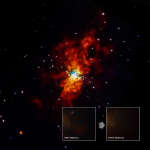 No X rays from SN 2014J
16.08.2014
Last January, telescopes in observatories around planet Earth were eagerly used to watch the rise of SN 2014J, a bright supernova in nearby galaxy M82. Still, the most important observations may have been from orbit where the Chandra X-ray Observatory saw nothing.
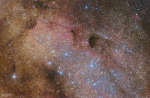 Messier 24: Sagittarius Star Cloud
7.04.2022
Unlike most entries in Charles Messier's famous catalog of deep sky objects, M24 is not a bright galaxy, star cluster, or nebula. It's a gap in nearby, obscuring interstellar dust clouds that allows a view of the distant stars in the Sagittarius spiral arm of our Milky Way galaxy.
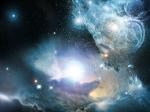 A Primodrial Quasar
20.05.2003
What did the first quasars look like? The nearest quasars are now known to be supermassive black holes in the centers of galaxies. Gas and dust that falls toward a quasar glows brightly, sometimes outglowing the entire home galaxy.
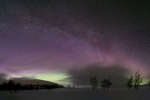 Sky Delights Over Sweden
15.04.2008
This night was a sky enthusiast's delight. While relaxing in Sweden last week, many a cosmic wonder was captured with a single snapshot. They are described here from near to far. In the foreground are nearby trees and more distant snow covered mountains.
|
January February March April May June July August September October |
|||||||||||||||||||||||||||||||||||||||||||||||||