
|
You entered: galaxies
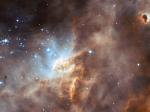 N11B: Star Cloud of the LMC
7.07.2004
Massive stars, abrasive winds, mountains of dust, and energetic light sculpt one of the largest and most picturesque regions of star formation in the Local Group of Galaxies. Known as N11, the region...
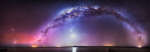 From the Northern to the Southern Cross
27.01.2019
There is a road that connects the Northern to the Southern Cross but you have to be at the right place and time to see it. The road, as pictured here, is actually...
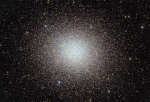 Millions of Stars in Omega Centauri
16.03.2023
Globular star cluster Omega Centauri, also known as NGC 5139, is 15,000 light-years away. The cluster is packed with about 10 million stars much older than the Sun within a volume about 150 light-years in diameter.
 NGC 604: Giant Stellar Nursery
25.04.2024
Located some 3 million light-years away in the arms of nearby spiral galaxy M33, giant stellar nursery NGC 604 is about 1,300 light-years across. That's nearly 100 times the size of the Milky Way's Orion Nebula, the closest large star forming region to planet Earth.
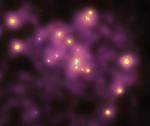 X For Andromeda
21.01.2000
A big beautiful spiral galaxy 2 million light-years away, Andromeda (M31) has long been touted as an analog to the Milky Way, a distant mirror of our own galaxy. The popular 1960s British sci-fi series, A For Andromeda, even postulated that it was home to another technological civilization that communicated with us.
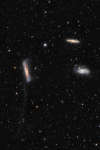 The Tidal Tail of NGC 3628
6.07.2012
A mere 30 million light-years away, large spiral galaxy NGC 3628 (center left) shares its neighborhood in the local Universe with two other large spirals, in a magnificent grouping otherwise known as the Leo Triplet.
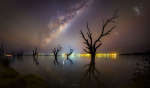 Dark Sky Reflections
29.06.2020
When the lake calmed down, many wonders of the land and sky appeared twice. Perhaps the most dramatic from the dark sky was the central band of our Milky Way Galaxy, visible as a diagonal band. Toward the right were both the Small (SMC) and Large (LMC) Magellanic Clouds, satellite galaxies of our Milky Way.
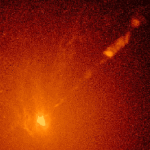 A Black Hole in M87's Center?
5.03.1996
The center of nearby giant galaxy M87 is a dense and violent place. In this 1994 photograph by the Hubble Space Telescope, a disk of hot gas was found to be orbiting at the center of this massive elliptical galaxy. The disk is evident on the lower left of the above photograph.
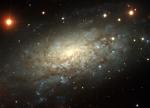 NGC 3621: Far Beyond the Local Group
19.07.2003
Far beyond the local group of galaxies lies NGC 3621, some 22 million light-years away. Found in the serpentine southern constellation Hydra, the loose spiral arms of this gorgeous island universe are loaded with luminous young star clusters and dark dust lanes.
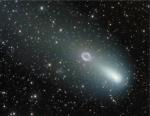 Comet Meets Ring Nebula: Part II
12.05.2006
Moving rapidly through planet Earth's night sky, Fragment C of crumbling comet 73P/Schwassmann-Wachmann 3 passed almost directly in front of M57 - the Ring Nebula, and faint spiral galaxy IC 1296 on May 8.
|
January February March April May June July August September October |
|||||||||||||||||||||||||||||||||||||||||||||||||