
|
You entered: galaxies
 Sgr A*: Fast Stars Near the Galactic Center
14.01.2007
Why are these stars moving so fast? Shown above is a time-lapse movie in infrared light detailing how stars in the central light-year of our Galaxy have moved over the past eight years.
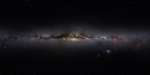 A Journey Through the Night Sky
20.05.2011
Majestic nebulae and stars of our Milky Way Galaxy stretch across this panoramic image of the entire night sky. At full resolution, the 5 gigapixel mosaic was stitched together from over 37,000 images...
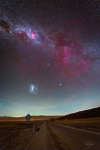 The Gum Nebula Supernova Remnant
29.11.2022
Because the Gum Nebula is the closest supernova remnant, it is actually hard to see. Spanning 40 degrees across the sky, the nebula appears so large and faint that it is easily lost in the din of a bright and complex background.
 APOD: 2023 December 12 Б Aurora and Milky Way over Norway
12.12.2023
What are these two giant arches across the sky? Perhaps the more familiar one, on the left, is the central band of our Milky Way Galaxy. This grand disk of stars and nebulas here appears to encircle much of the southern sky.
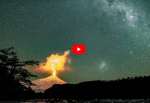 APOD: 2024 July 17 Б Villarrica Volcano Against the Sky
17.07.2024
When Vulcan, the Roman god of fire, swings his blacksmith's hammer, the sky is lit on fire. A recent eruption of Chile's Villarrica volcano shows the delicate interplay between this fire -- actually...
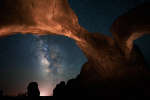 Three Arches Above Utah
24.05.2011
How many arches can you count in the above image? If you count both spans of the Double Arch in the Arches National Park in Utah, USA, then two. But since the above image...
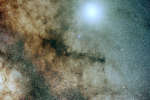 The Planet and the Pipe
7.06.2019
Now posing against our galaxy's rich starfields and nebulae, brilliant planet Jupiter shines in the night sky. Its almost overwhelming glow is near the top of the frame in this colorful telephoto portrait of the central Milky Way.
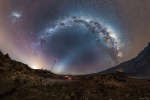 Milky Way and Zodiacal Light over Chile
9.03.2020
What is the band of light connecting the ground to the Milky Way? Zodiacal light -- a stream of dust that orbits the Sun in the inner Solar System. It is most easily seen just before sunrise, where it has been called a false dawn, or just after sunset.
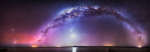 From the Northern to the Southern Cross
27.01.2014
There is a road that connects the Northern to the Southern Cross but you have to be at the right place and time to see it. The road, as pictured above, is actually...
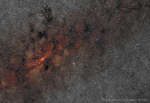 The Galactic Center in Infrared
17.01.2016
The center of our Galaxy is a busy place. In visible light, much of the Galactic Center is obscured by opaque dust. In infrared light, however, dust glows more and obscures less, allowing nearly one million stars to be recorded in the featured photograph.
|
January February March April May June July August September October |
|||||||||||||||||||||||||||||||||||||||||||||||||