
|
You entered: galaxies
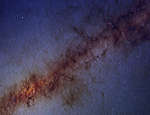 The Galactic Center in Infrared from 2MASS
30.05.2010
The center of our Galaxy is a busy place. In visible light, much of the Galactic Center is obscured by opaque dust. In infrared light, however, dust glows more and obscures less, allowing nearly one million stars to be recorded in the above image.
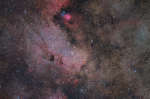 Messier 24: Sagittarius Star Cloud
18.07.2024
Unlike most entries in Charles Messier's famous catalog of deep sky objects, M24 is not a bright galaxy, star cluster, or nebula. It's a gap in nearby, obscuring interstellar dust clouds that allows a view of the distant stars in the Sagittarius spiral arm of our Milky Way galaxy.
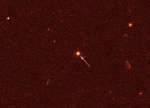 The GRB 110328A Symphony
19.04.2011
A symphony of planet-wide observations began abruptly on March 28 when the Earth-orbiting Swift satellite detected a burst of high-frequency gamma-rays from GRB 110328A. When the same source flared again after a 45 minute pause it was clear this event was not a typical gamma-ray burst.
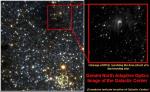 Gemini North Images Bow Shock Near Galactic Center
17.10.2000
What's going on near the center of our Galaxy? Glowing across the electromagnetic spectrum, the center of our Milky Way Galaxy is thought to be home to massive stars, rotating gas rings, and a massive black hole. Now the central Galactic zoo just got larger.
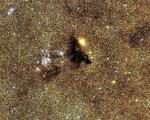 Open Cluster NGC 6520 from CFHT
22.07.2002
Did you ever have a day when it felt like a dark cloud was following you around? For the open cluster of stars NGC 6520, every day is like this. On the left of the above picture are many of NGC 6520's bright blue stars.
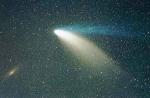 Hale-Bopp and Andromeda
1.04.1997
Which is closer: the comet or the galaxy? Answer: the comet. In its trek through the inner Solar System, Comet Hale-Bopp has passed nearly in front of the Andromeda Galaxy (M31), seen on the lower left.
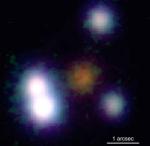 PG 1115+080: A Gravitational Cloverleaf
31.03.1999
All four blue images in the above photograph are the same object. The gravitational lens effect of the red, foreground, elliptical galaxy visible near image center creates a cloverleaf image of the single distant quasar. Light from the quasar is pulled around the massive galaxy in different paths, corresponding to different images.
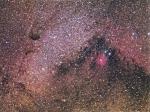 M24: A Sagittarius Starscape
21.09.2004
Many vast star fields in the plane of our Milky Way Galaxy are rich in clouds of dust, and gas. First and foremost, visible in the above picture are millions of stars, many of which are similar to our Sun.
 N11: Star Clouds of the LMC
11.02.2013
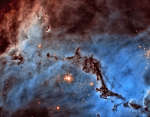
Massive stars, abrasive winds, mountains of dust, and energetic light sculpt one of the largest and most picturesque regions of star formation in the Local Group of Galaxies. Known as N11, the region...
 Messier 24: Sagittarius Star Cloud
29.06.2018
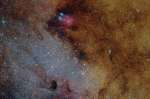
Unlike most entries in Charles Messier's famous catalog of deep sky objects, M24 is not a bright galaxy, star cluster, or nebula. It's a gap in nearby, obscuring intertellar dust clouds that allows a view of the distant stars in the Sagittarius spiral arm of our Milky Way galaxy.
|
January February March April May June July August September October |
|||||||||||||||||||||||||||||||||||||||||||||||||