
|
You entered: X-ray
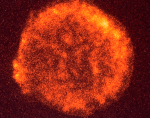 Tychos Supernova Remnant in X ray
7.03.1999
How often do stars explode? By looking at external galaxies, astronomers can guess that these events, known as a supernovae, should occur about once every 30 years in a typical spiral galaxy like our MilkyWay.
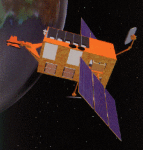 The X-ray Timing Explorer
3.01.1996
Launched Saturday on a Delta rocket, the X-ray Timing Explorer (XTE) will watch the sky for rapid changes in X-rays. XTE carries three separate X-ray telescopes. The Proportional Counter Array (PCA) and the High Energy X-ray Timing Experiment (HEXTE) will provide the best timing information in the widest X-ray energy range yet available.
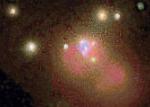 The Center of the Circinus Galaxy in X Rays
16.05.2001
Are black holes the cause of X-rays that pour out from the center of the Circinus galaxy? A new high-resolution image from the orbiting Chandra X-ray Observatory has resolved the inner regions of this nearby galaxy into several smaller sources. The image is shown above in representative-color.
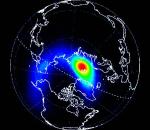 X-Ray Earth
16.09.2000
Above is a picture of the Earth in x-rays, taken in March of 1996 from the orbiting Polar satellite. Most of the planet is dark with superposed continent and coordinate grids, while the bright x-ray emission near the north pole is shown in red. Why does the Earth have an x-ray glow?
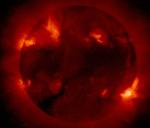 Solstice Sun In Soft X-rays
21.12.1998
The solstice occurs today at 8:56 PM Eastern Standard Time. At the solstice the sun reaches its most southerly position in the sky and winter begins for the Northern Hemisphere while summer starts South of the Equator.
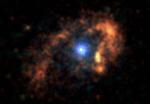 Eta Carinae in X Rays
11.10.1999
Eta Carinae is the one of the most luminous star systems in our Galaxy, radiating millions of times more power than our Sun. Eta Carinae is also one of the strangest star systems known, brightening and fading greatly since the early 1800s.
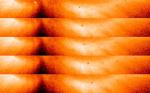 X ray Transit of Mercury
6.11.1999
This sequence of false color X-ray images captures a rare event - the passage or transit of planet Mercury in front of the Sun. Mercury's small disk is silhouetted against the bright background of X-rays from the hot Solar Corona.
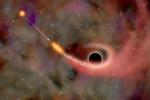 X Rays Indicate Star Ripped Up by Black Hole
24.02.2004
What could rip a star apart? A black hole. Giant black holes in just the right mass range would pull on the front of a closely passing star much more strongly than on the back.
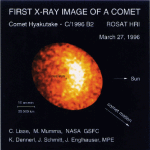 Unexpected X-rays from Comet Hyakutake
11.04.1996
The first X-rays ever detected from a comet were discovered from Comet Hyakutake with the ROSAT satellite on March 27th. The discovery is particularly surprising because there was little previous indication that comets emit any significant X-radiation.
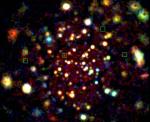 X-Ray Pleiades
18.03.1997
The Pleiades star cluster is one of the jewels of the northern sky. To the unaided eye it appears as a lovely and tantalizing grouping of stars in the constellation of Taurus, while telescopic views reveal cluster stars surrounded by delicate blue wisps of dust-reflected starlight.
|
January February March April May June July August September October |
|||||||||||||||||||||||||||||||||||||||||||||||||