
|
You entered: nucleus
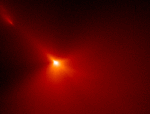 Near the Nucleus of Hyakutake
28.03.1996
NASA's Hubble Space Telescope captured this image of the near-nuclear region of Comet Hyakutake on March 25 as the comet approached within 9.3 million miles of the Earth. It covers a relatively "small" 2,000 mile wide area with the sunward direction toward the lower right (tailward is upper left).
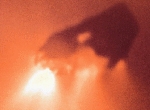 An Orbiting Iceberg
21.08.1995
A comet nucleus, formed from the primordial stuff of the solar system, resembles a very dirty iceberg. Orbiting far from our Sun, it can remain frozen, preserved for billions of years. Occasionally, a chance gravitational encounter will alter this distant orbit and send the nucleus plummeting towards the inner solar system.
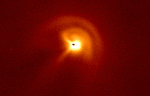 The Rotating Jets of Comet Hyakutake
14.04.1996
Comet Hyakutake will reach its closest point to the Sun on May 1, passing well inside the orbit of Mercury. At this time, the comet's dust and ion tail will be at their greatest physical length.
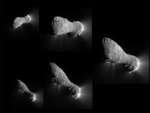 Comet Hartley 2 Flyby
5.11.2010
Follow these 5 frames clockwise starting from the top left to track the view from the EPOXI mission spacecraft as it approached, passed under, and then looked back at the nucleus of comet Hartley 2 on November 4. Its closest approach distance was about 700 kilometers.
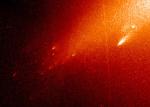 Comet LINEAR Disperses
8.08.2000
What's happened to the nucleus of Comet LINEAR? The brightest comet this year has unexpectedly broken up into many smaller pieces. The break-up occurred on or about July 25 and was noted by many astronomers around the world with particularly pioneering work by Mark Kidger (IAC).
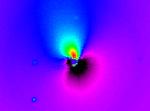 A Dust Jet From Hale-Bopp
29.07.1996
Approaching the inner Solar System, comet Hale-Bopp's icy nucleus is heated by sunlight, accelerating its production of dust and gas. Shrouded in the resulting cloud, known as the coma, the cometary nucleus remains hidden from direct view.
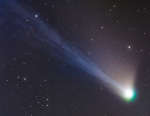 Tails of Comet Lemmon
6.05.2013
What caused the interestingly intricate tails that Comet Lemmon displayed earlier this year? First of all, just about every comet that nears the Sun displays two tails: a dust tail and an ion tail.
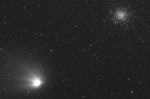 Comet Hale-Bopp Passes M14
12.11.1996
Comet Hale-Bopp continues its slow trek across the night sky, and can now be seen superposed near the bright globular cluster M14. Will Comet Hale-Bopp become as bright in early 1997 as Comet Hyakutake did in early 1996? It is still too early to tell.
 Comet Hale-Bopp Over Val Parola Pass
27.05.2001
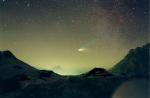
Comet Hale-Bopp became much brighter than any surrounding stars. It was seen even over bright city lights. Out away from city lights, however, it put on quite a spectacular show. Here Comet Hale-Bopp was photographed above Val Parola Pass in the Dolomite mountains surrounding Cortina d'Ampezzo, Italy.
 Comet Hale Bopp Over Val Parola Pass
14.03.2004
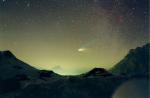
Comet Hale-Bopp became much brighter than any surrounding stars. It was seen even over bright city lights. Out away from city lights, however, it put on quite a spectacular show. Here Comet Hale-Bopp was photographed above Val Parola Pass in the Dolomite mountains surrounding Cortina d'Ampezzo, Italy.
|
January February March April May June July August September |
|||||||||||||||||||||||||||||||||||||||||||||||||