
|
You entered: nucleus
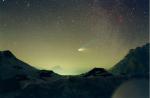 Comet Hale Bopp Over Val Parola Pass
4.09.2005
Comet Hale-Bopp became much brighter than any surrounding stars. It was seen even over bright city lights. Out away from city lights, however, it put on quite a spectacular show. Here Comet Hale-Bopp was photographed above Val Parola Pass in the Dolomite mountains surrounding Cortina d'Ampezzo, Italy.
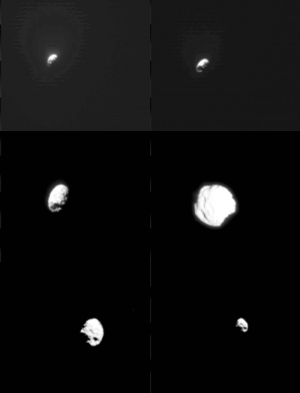 STARDUST Flyby of Comet Wild 2
19.01.2004
Flying past a comet nucleus is dangerous. On January 2, the robot spacecraft STARDUST became one of the first to plow through the surrounding cloud of dust and grit to photograph the very heart of a comet.
 Comet Hale Bopp Over Val Parola Pass
2.03.2008
Comet Hale-Bopp, the Great Comet of 1997, became much brighter than any surrounding stars. It was seen even over bright city lights. Away from city lights, however, it put on quite a spectacular show. Here Comet Hale-Bopp was photographed above Val Parola Pass in the Dolomite mountains surrounding Cortina d'Ampezzo, Italy.
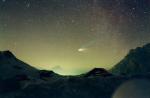 Comet Hale-Bopp Over Val Parola Pass
8.08.1999
Comet Hale-Bopp became much brighter than any surrounding stars. It was seen even over bright city lights. Out away from city lights, however, it put on quite a spectacular show. Here Comet Hale-Bopp was photographed above Val Parola Pass in the Dolomite mountains surrounding Cortina d'Ampezzo, Italy.
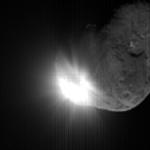 Thirteen Seconds After Impact
5.07.2005
Fireworks came early on July 4th when, at 1:52am EDT, the Deep Impact spacecraft's probe smashed into the surface of Comet Tempel 1's nucleus at ten kilometers per second. The well-targeted impactor probe was vaporized as it blasted out an expanding cloud of material, seen here 13 seconds after the collision.
 Perihelion Approaches
15.08.2015
This dramatic outburst from the nucleus of Comet 67P/Churyumov-Gerasimenko occured on August 12, just hours before perihelion, its closest approach to the Sun. Completing an orbit of the Sun once every 6.45 years, perihelion distance for this periodic comet is about 1.3 astronomical units (AU), still outside the orbit of planet Earth (at 1 AU).
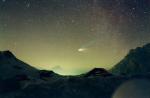 Comet Hale Bopp Over Val Parola Pass
28.06.1998
In 1997, Comet Hale-Bopp became much brighter than any surrounding stars. It could be seen even over bright city lights. Out away from city lights, however, it put on quite a spectacular show. Here Comet Hale-Bopp was photographed last March above Val Parola Pass in the Dolomite mountains surrounding Cortina d'Ampezzo, Italy.
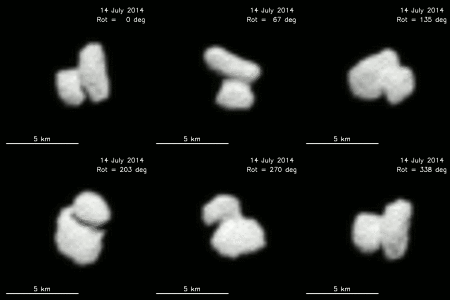 Spacecraft Rosetta Shows Comet has Two Components
21.07.2014
Why does this comet's nucleus have two components? The surprising discovery that Comet 67P/ChuryumovGerasimenko has a double nucleus came late last week as ESA's robotic interplanetary spacecraft Rosetta continued its approach toward the ancient comet's core.
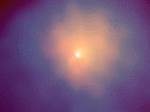 Hyakutake: Comet Atmosphere
10.04.1998
The atmosphere of a comet comes and goes. Approaching the sun, it swells as material from the icy cometary nucleus is warmed and evaporated by increasing sunlight. Immense but tenuous and fleeting, the inner atmosphere or inner "coma" of comet Hyakutake is seen in this false color picture.
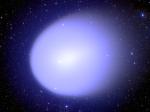 Expansive Comet Holmes
21.11.2007
The spherical coma of Comet Holmes has swollen to a diameter of over 1.4 million kilometers, making the tenuous, dusty cloud even bigger than the Sun. Scattering sunlight, all that dust and gas came...
|
January February March April May June July August September |
|||||||||||||||||||||||||||||||||||||||||||||||||