
|
You entered: universe
 Edwin Hubble Discovers the Universe
17.02.1996
No person in history has had greater impact in determining the extent of our universe than Edwin Hubble. From proving that other galaxies existed to proving that galaxies move apart from one another, Hubble's work defined our place in the cosmos.
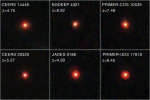 APOD: 2025 December 24 Б Mystery: Little Red Dots in the Early Universe
24.12.2025
What are these little red dots (LRDs)? Nobody knows. Discovered only last year, hundreds of LRDs have now been found by the James Webb Space Telescope in the early universe. Although extremely faint, LRDs are now frequently identified in deep observations made for other purposes.
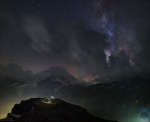 Observatory, Mountains, Universe
29.12.2014
The awesomeness in this image comes in layers. The closest layer, in the foreground, contains the Peak Terskol Observatory located in the northern Caucasus Mountains of Russia. The white dome over the 2-meter telescope is clearly visible. The observatory is located on a shoulder of Mt.
 The Universe Evolves
30.06.1998
Scroll right and watch the universe evolve. Above is a computer simulation depicting the evolution of our entire universe. On the far left is a slice of the universe soon after the Big Bang - over 10 billion years ago.
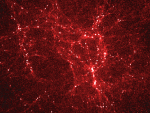 The Early Universe
14.06.1997
What did our universe look like when it was young? To answer this, cosmologists run sophisticated computer programs tracking the locations of millions of particles. The above animated frame is the result of such a calculation and shows how our universe might have looked when it was just a fracton of its current age.
 Multiverses: Do Other Universes Exist
1.03.2006
Do nearly exact copies of you exist in other universes? If one or more of the multiverse hypotheses is correct, then quite possibly they do. In the above computer-enhanced illustration, independent universes are shown as independent circles or spheres. Spheres may be causally disconnected from all other spheres, meaning no communications can pass between them.
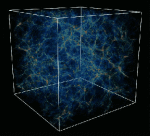 Simulating the Universe
8.11.1995
The above cube represents a chunk of our universe as simulated by the Grand Challenge Cosmology Consortium (GC3). The cube is huge - it would take light 500 million years to cross it. Low density gas is shown as blue, and high density gas as red.
 The Universe Evolves
5.09.1999
Scroll right and watch the universe evolve. Above is a computer simulation depicting the evolution of our entire universe. On the far left is a slice of the universe soon after the Big Bang - over 10 billion years ago.
 A Universe in a Box
21.08.1997
Is this our universe? Possibly. It is one computerized guess of how gas in the universe was distributed billions of years ago, at redshift 3, when the universe was only a quarter of its present age.
 Multiverses: Do Other Universes Exist?
14.11.2010
Do nearly exact copies of you exist in other universes? If one or more of the multiverse hypotheses is correct, then quite possibly they do. In the above computer-enhanced illustration, independent universes are shown as independent circles or spheres. Spheres may be causally disconnected from all other spheres, meaning no communications can pass between them.
|
January February March April May June July August September October |
|||||||||||||||||||||||||||||||||||||||||||||||||