
|
You entered: constellation
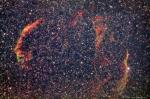 Wisps of the Veil Nebula
4.02.2003
These wisps of gas are all that remain visible of a Milky Way star. Many thousands of years ago that star exploded in a supernova leaving the Veil Nebula, pictured above. At the time...
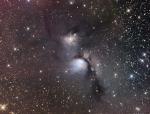 M78: Stardust and Starlight
4.11.2005
Interstellar dust clouds and bright nebulae abound in the fertile constellation of Orion. One of the brightest, M78, is just below center in this sharp widefield view, covering an area north of Orion's belt. At a distance of about 1,500 light-years, the bluish nebula itself is about 5 light-years across.
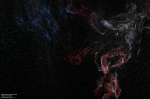 NGC 7841: The Smoke Nebula in Frustriaus
1.11.2013
NGC 7841 is probably known as the Smoke Nebula, found in the modern constellation of Frustriaus, the frustrated astrophotographer. Only a few light-nanoseconds from planet Earth, The Smoke Nebula is not an expanding supernova remnant along the plane of our Milky Way galaxy, though it does look a lot like one.
 Helping Hand in Cassiopeia
8.11.2024
Drifting near the plane of our Milky Way galaxy these dusty molecular clouds seem to extend a helping hand on a cosmic scale. Part of a local complex of star-forming interstellar clouds they include LDN 1358, 1357, and 1355 from American astronomer Beverly Lynds' 1962 Catalog of Dark Nebulae.
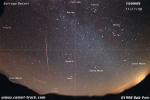 An Annotated Leonid
11.11.2001
The 1998 Leonids Meteor Shower was one of the most photographed meteor event in history. Patient observers saw bright meteors streak across dark skies every few minutes, frequently leaving fading trails stretching across the sky. High above the Anza-Borrego Desert, a meteor was photographed streaking up from the radiant constellation of the Leonids: Leo.
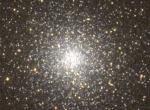 Globular Cluster 47 Tucanae
19.09.1997
Stars come in bunches. Of the over 200 globular star clusters that orbit the center of our Milky Way Galaxy, 47 Tucanae is the second brightest globular cluster (behind Omega Centauri). Known to some affectionately as 47 Tuc or NGC 104, it is only visible from the Southern Hemisphere.
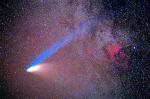 Hale Bopp and the North American Nebula
9.10.1997
Comet Hale-Bopp's recent encounter with the inner Solar System allowed many breath-taking pictures. Above, Comet Hale-Bopp was photographed on March 8th in the constellation of Cygnus. Visible on the right in red is the North American Nebula, a bright emission nebula observable from a dark location with binoculars.
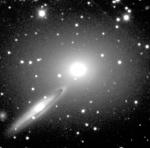 Seeing Through Galaxies
5.12.1997
In this dramatic picture, spiral galaxy NGC 5091 appears in the foreground. Tilted nearly edge-on, the dust lanes between its spiral arms are clearly visible. The large elliptical galaxy NGC 5090 lies just beyond it - both are about 100 million light years distant in the southern constellation Centaurus. Can you see through the spiral galaxy?
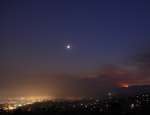 Planets and Fire by Moonlight
9.07.2008
On July 5th, wandering planets, bright stars, and a young crescent Moon graced western skies after sunset. Arrayed along the solar system's ecliptic plane, the three celestial beacons forming this skyscape's eye-catching line-up with the Moon are Saturn (upper left), then Mars, and finally Regulus, alpha star of the constellation Leo.
 Rosetta and Comet Outbound
28.11.2015
Not a bright comet, 67P/Churyumov-Gerasimenko now sweeps slowly through planet Earth's predawn skies near the line-up of planets along the ecliptic. Still, this composite of telescopic images follows the comet's progress as it moves away from the Sun beyond the orbit of Mars, from late September (left) through late November (far right).
|
January February March April May June July August September October |
|||||||||||||||||||||||||||||||||||||||||||||||||