
|
You entered: constellation
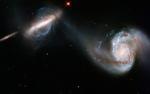 Peculiar Arp 87
1.11.2007
A cosmic bridge of stars, gas, and dust stretches for over 75,000 light-years and joins this peculiar pair of galaxies cataloged as Arp 87. The bridge is strong evidence that these two immense star systems have passed close to each other and experienced violent tides induced by mutual gravity.
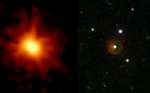 Across the Universe
28.03.2008
How far can you see? Even the faintest stars visible to the eye are merely hundreds or thousands of light-years distant, all well within our own Milky Way Galaxy. Of course, if you know where to look you can also spot the Andromeda Galaxy as a pale, fuzzy cloud, around 2.5 million light-years away.
 Arp 87: Merging Galaxies from Hubble
9.12.2015
This dance is to the death. Along the way, as these two large galaxies duel, a cosmic bridge of stars, gas, and dust currently stretches over 75,000 light-years and joins them. The bridge...
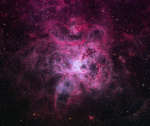 The Tarantula Nebula
17.11.2018
The Tarantula Nebula, also known as 30 Doradus, is more than a thousand light-years in diameter, a giant star forming region within nearby satellite galaxy the Large Magellanic Cloud. About 180 thousand light-years away, it's the largest, most violent star forming region known in the whole Local Group of galaxies.
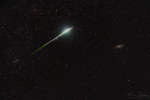 Island Universe, Cosmic Sand
14.08.2021
Stars in our own Milky Way Galaxy are scattered through this eye-catching field of view. From the early hours after midnight on August 13, the 30 second exposure of the night sky over Busko-Zdroj, Poland records the colorful and bright trail of a Perseid meteor.
 APOD: 2025 April 14 Б The Galactic Center in Radio from MeerKAT
14.04.2025
What's happening at the center of our galaxy? It's hard to tell with optical telescopes since visible light is blocked by intervening interstellar dust. In other bands of light, though, such as radio, the galactic center can be imaged and shows itself to be quite an interesting and active place.
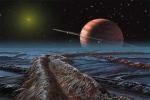 Other Worlds and HD 38529
10.08.2000
After the latest round of discovery announcements, the list of known worlds of distant suns has grown to 50. While extrasolar planet discoveries are sure to continue, none - so far - points clearly to another planetary system like our own. Take, for example, the newly discovered parent star HD38529.
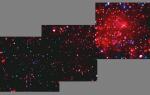 X Ray Stars and Winds in the Rosette Nebula
19.10.2001
This mosaic of x-ray images cuts a swath across the photogenic Rosette Nebula, a stellar nursery 5,000 light-years from Earth in the constellation Monoceros, the Unicorn. Constructed from data recorded by the orbiting...
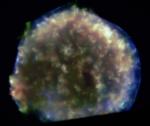 X Rays From Tycho s Supernova Remnant
22.05.2004
In 1572, Danish astronomer Tycho Brahe recorded the sudden appearance of a bright new star in the constellation Cassiopeia. The new star faded from view over a period of months and is believed to have been a supernova, one of the last stellar explosions seen in our Milky Way galaxy.
 A Dark Sky Over Sequoia National Park
27.08.2009
Scroll right to take in the view from the highest summit in the contiguous USA. The above 360-degree digitally stitched panorama, taken in mid-July, shows the view from 4,400-meter high Mt. Whitney in Sequoia National Park, California. In the foreground, angular boulders populate Mt.
|
January February March April May June July August September October |
|||||||||||||||||||||||||||||||||||||||||||||||||