
|
You entered: constellation
 APOD: 2024 March 18 Б Comet Pons Brooks Swirling Coma
18.03.2024
A bright comet will be visible during next month's total solar eclipse. This very unusual coincidence occurs because Comet 12P/Pons-Brooks's return to the inner Solar System places it by chance only 25 degrees away from the Sun during Earth's April 8 total solar eclipse.
 EUVE Sky Map
31.01.2002
The stars beyond the Sun and the distant galaxies should be undetectable at extreme ultraviolet wavelengths. At least that was the conventional wisdom when it was first realized that the space between the stars is filled with hydrogen, a strong absorber of extreme ultraviolet light.
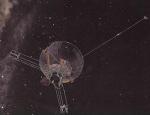 Pioneer 10: The First 6 Billion Miles
3.03.1997
Q: What was made by humans and is 6 billion miles away? A: Pioneer 10 - and yesterday was the 25th anniversary of its launch. More than 9 light hours distant, Pioneer 10 is presently about twice as far from the Sun as Pluto, bound for interstellar space at 28,000 miles per hour.
 Pickering s Triangle in the Veil
17.09.2015
Chaotic in appearance, these filaments of shocked, glowing gas break across planet Earth's sky toward the constellation of Cygnus, as part of the Veil Nebula. The Veil Nebula itself is a large supernova remnant, an expanding cloud born of the death explosion of a massive star.
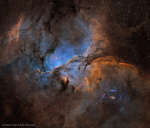 NGC 6188 and NGC 6164
30.03.2016
Fantastic shapes lurk in clouds of glowing gas in the giant star forming region NGC 6188. The emission nebula is found about 4,000 light years away near the edge of a large molecular cloud unseen at visible wavelengths, in the southern constellation Ara.
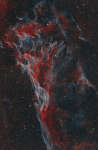 Williamina Fleming s Triangular Wisp
10.11.2017
Chaotic in appearance, these tangled filaments of shocked, glowing gas are spread across planet Earth's sky toward the constellation of Cygnus as part of the Veil Nebula. The Veil Nebula itself is a large supernova remnant, an expanding cloud born of the death explosion of a massive star.
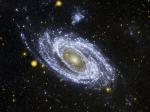 Bright Spiral Galaxy M81 in Ultraviolet from Galex
15.05.2007
Where are the hot stars in M81, one of the closest major spiral galaxies? To help find out, astronomers took a deep image in ultraviolet light of the sprawling spiral with the Earth-orbiting Galex telescope.
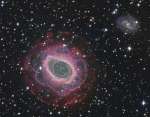 Ring Nebula Deep Field
6.11.2009
A familiar sight to sky enthusiasts with even a small telescope, the Ring Nebula (M57) is some 2,000 light-years away in the musical constellation Lyra. The central ring is about one light-year across...
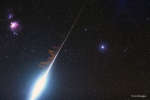 A Blazing Fireball between the Orion Nebula and Rigel
16.11.2015
What's happening to that meteor? A few days ago, a bright fireball was photographed from the Alps mountain range in Switzerland as it blazed across the sky. The fireball, likely from the Taurids...
 Mira Over Germany
21.02.2007
What's that new star in the sky? The star might appear new, but it's actually just the variable star Mira near its brightest. Rolling your cursor over the above vertically compressed image...
|
January February March April May June July August September October |
|||||||||||||||||||||||||||||||||||||||||||||||||