
|
You entered: launch
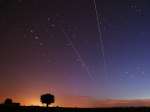 Chasing the ISS
4.06.2008
Bathed in sunlight, the International Space Station (ISS) arced through the evening sky above the town of Lauffen in southern Germany on May 31st. The timing of the bright passage was about 10 minutes after the launch of the Space Shuttle Discovery on the STS-124 mission from Kennedy Space Center, Florida, in the southeastern US.
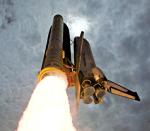 Recycling Columbia
15.11.2001
Twenty years ago this week, the Space Shuttle Columbia became the first reusable spaceship. Its second trip to low Earth orbit and back again began on November 12, 1981, following its maiden voyage by only seven months.
 JWST on the Road to L2
31.12.2021
This timelapse gif tracks the James Webb Space Telescope as it streaks across the stars of Orion on its journey to a destination beyond the Moon. Recorded on December 28, 12 consecutive exposures each 10 minutes long were aligned and combined with a subsequent color image of the background stars to create the animation.
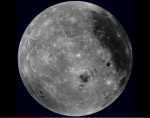 Rotating Moon from LRO
16.09.2013
No one, presently, sees the Moon rotate like this. That's because the Earth's moon is tidally locked to the Earth, showing us only one side. Given modern digital technology, however, combined with many detailed images returned by the Lunar Reconnaissance Orbiter (LRO), a high resolution virtual Moon rotation movie has now been composed.
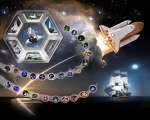 Space Shuttle Tribute Poster: Endeavour
7.09.2010
They are some of the most complex machines ever built. From a standing start they can launch a school- bus sized object up so high and moving so fast that it won't fall back down.
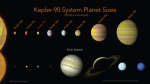 The Kepler 90 Planetary System
28.04.2020
Do other stars have planetary systems like our own? Yes -- one such system is Kepler-90. Cataloged by the Kepler satellite that operated from Earth orbit between 2009 and 2018, eight planets were discovered, giving Kepler-90 the same number of known planets as our Solar System.
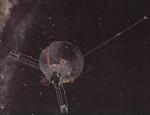 Pioneer 10: The First 7 Billion Miles
25.08.2001
Q: What was made by humans and is 7.3 billion miles away? A: Pioneer 10 -- and 1997 was the 25th anniversary of its launch. Almost 11 light-hours distant, Pioneer 10 is presently about twice as far from the Sun as Pluto, and bound for interstellar space at 28,000 miles per hour.
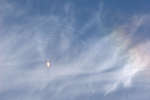 Exceptional Rocket Waves Destroy Sun Dog
23.02.2010
What created those rocket waves, and why did they destroy that sun dog? Close inspection of the above image shows not only a rocket rising near the center, but unusual air ripples around it and a colorful sundog to the far right.
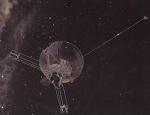 Pioneer 10: The First 6 Billion Miles
20.06.1998
Q: What was made by humans and is 6.5 billion miles away? A: Pioneer 10 - and last year was the 25th anniversary of its launch. More than 9.5 light-hours distant, Pioneer 10 is presently about twice as far from the Sun as Pluto, bound for interstellar space at 28,000 miles per hour.
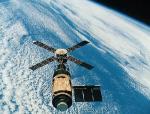 Skylab Over Earth
10.05.1998
Skylab was an orbiting laboratory launched by a Saturn V rocket in May 1973. Skylab was visited three times by NASA astronauts who sometimes stayed as long as two and a half months. Many scientific tests were performed on Skylab, including astronomical observations in ultraviolet and X-ray light.
|
January February March April May June July August September October |
|||||||||||||||||||||||||||||||||||||||||||||||||