
|
You entered: launch
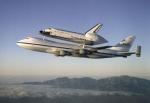 Shuttle Ferry
5.08.2003
How does a space shuttle that landed in California get back to Florida for its next launch? The answer is by ferry. NASA operates two commercial Boeing 747 airplanes modified to carry a space shuttle on their backs.
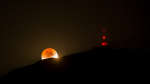 Shadowed Moon and Mountain
18.07.2019
On July 16 the Moon celebrated the 50th anniversary of the launch of Apollo 11 with a lunar eclipse visible from much of planet Earth. In this view part of the lunar disk is immersed in Earth's dark, reddened umbral shadow. Near the maximum eclipse phase, it just touches down along a mountain ridge.
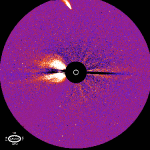 Comet Hyakutake and a Solar Flare
17.05.1996
A rare coincidence was recently captured by the orbiting SOHO spacecraft. During the closest approach to the Sun of Comet Hyakutake on May 1, SOHO photographed the comet. By accident -- during the time this photograph was being taken -- a solar flare was being ejected from the Sun.
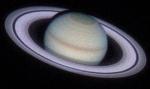 Saturn in Color
12.03.1997
Saturn is unusual but photogenic. The second largest planet in our Solar System, behind Jupiter, has been easily identifiable at night since history has been recorded. It was only with the invention of the telescope, however, that any evidence of its majestic ring system became apparent.
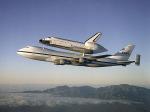 Shuttle Ferry
8.07.2007
How does a space shuttle that landed in California get back to Florida for its next launch? The answer is by ferry. NASA operates two commercial Boeing 747 airplanes modified to carry a space shuttle on their backs.
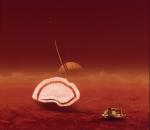 A Portrait of Saturn from Titan
13.10.2001
This artistic portrait of Saturn depicts how it might look from Titan, Saturn's largest moon. In the foreground sits ESA's Huygens probe, which will be released by NASA's Cassini spacecraft and parachute to Titan's surface. Cassini will reach Saturn in 2004 and release the Huygens probe later that year.
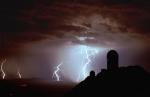 Lightning on Earth
17.07.2000
Nobody knows what causes lightning. It is known that charges slowly separate in some clouds causing rapid electrical discharges (lightning), but how electrical charges get separated in clouds remains a topic of much research.
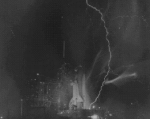 Lightning and the Space Shuttle
10.11.1995
There are many things about lightning that are not understood. Lightning has been seen in the atmospheres of Venus, Earth, Jupiter, and Saturn. A leading theory is that collisions of particles in clouds cause large areas of positive and negative charge.
 Liftoff With the Space Shuttle
23.10.2002
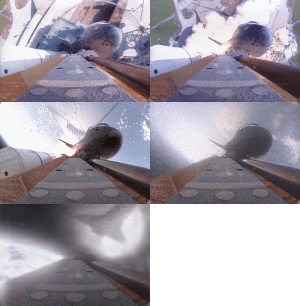
What would it look like to see a Space Shuttle liftoff from just above the shuttle? Because the answer has value in assessing spacecraft performance, NASA attached a small RocketCam to the side of the External Tank on the launch of the Space Shuttle Atlantis earlier this month.
 Catching Falling Stardust
17.11.2001
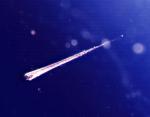
This carrot-shaped track is actually little more than 5 hundredths of an inch long. It is the trail of a meteroid through the high-tech substance aerogel exposed to space by the shuttle launched EURECA (European Recoverable Carrier) spacecraft.
|
January February March April May June July August September October |
|||||||||||||||||||||||||||||||||||||||||||||||||