
|
You entered: launch
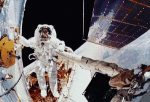 Repairing Hubble
16.11.1995
The first Hubble Space Telescope (HST) servicing mission, STS-61, was one of the most complicated shuttle missions ever planned. Launched on December 2, 1993 in the Space Shuttle Endeavor, the astronauts were required to make 5 space walks to repair the HST. Astronaut F.
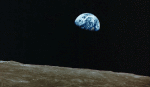 Earth Rise
25.12.1995
During the 1968 Christmas season Frank Borman, James Lovell, and William Anders flew the Apollo 8 command module From the Earth to the Moon and back (launched Dec. 21, achieved 10 lunar orbits, landed Dec. 27).
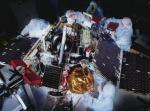 Invader From Earth
8.01.1999
These technicians are working on the solar-paneled Mars Polar Lander - yet another robotic spacecraft scheduled to invade the red planet. Mars Polar Lander is part of a series of missions focusing on a search for evidence of past or present life.
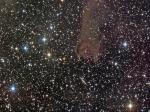 CG4: A Ruptured Cometary Globule
6.08.2007
Can a gas cloud eat a galaxy? It's not even close. The odd looking "creature" or "hand" extending down from the top of the above photo is a gas cloud known as a cometary globule. This globule, however, has ruptured. Cometary globules are typically characterized by dusty heads and elongated tails.
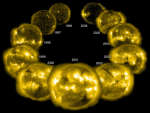 A Complete Solar Cycle from SOHO
3.12.2007
Every eleven years, our Sun goes through a solar cycle. A complete solar cycle has now been imaged by the sun-orbiting SOHO spacecraft, celebrating the 12th anniversary of its launch yesterday. A solar cycle...
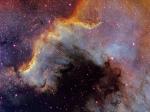 The Cygnus Wall of Star Formation
21.06.2005
The North America Nebula in the sky can do what North Americans on Earth cannot -- form stars. Specifically, in analogy to the Earth-confined continent, the bright part that appears as Central America and Mexico is actually a hot bed of gas, dust, and newly formed stars known as the Cygnus Wall.
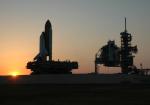 Discovery in Motion
8.07.2006
On July 4th, the space shuttle orbiter Discovery rocketed into space on mission STS-121. Now docked with the International Space Station, Discovery orbits planet Earth at about 27 thousand kilometers per hour.
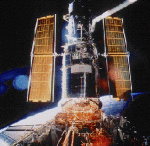 The Orbiting Hubble Space Telescope
10.08.1995
The Hubble Space Telescope (HST) is the largest orbiting public optical telescope in history. Its 2.4 meter diameter reflecting mirror and its perch above Earth's atmosphere allow it to create exceptionally sharp images.
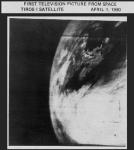 Planet Earth From TIROS 1: First TV Image
1.04.2000
The Television InfraRed Observational Satellite (TIROS) 1 was the first weather satellite. Launched into a polar orbit 40 years ago (April 1, 1960) equipped with two TV cameras, TIROS 1 was operational for only 78 days but demonstrated the feasibility of monitoring planet Earth's cloud cover and weather patterns from space.
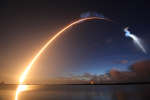 Atlas V Rising
5.09.2015
Early morning risers along Florida's Space Coast, planet Earth, were treated to a launch spectacle on September 2nd. Before dawn an Atlas V rocket rose into still dark skies carrying a US Navy communications satellite from Cape Canaveral Air Force Station into Earth orbit.
|
January February March April May June July August September October |
|||||||||||||||||||||||||||||||||||||||||||||||||