
|
You entered: gas
 Red Saturn
10.02.2005
This strange, false-color image of otherwise familiar planet Saturn shows temperature changes based on thermal infrared emission in the gas giant's atmosphere and rings. Recorded from the Keck I telescope on Mauna Kea, the sharp, ground-based picture of Saturn's southern hemisphere is a mosaic of 35 images.
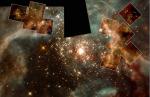 Massive Stars Of 30 Doradus
30.09.1999
This gorgeous visible-light Hubble Space Telescope image shows a young cluster of massive stars at the center of the 30 Doradus Nebula. Gas and dust clouds in 30 Doradus, also known as the Tarantula Nebula, have been sculpted into elongated shapes by powerful winds and ultraviolet radiation from these hot cluster stars.
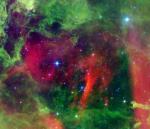 Hot Stars in the Rosette Nebula
26.07.2007
Winds and radiation from massive hot stars in the Rosette Nebula have cleared the natal gas and dust from the center of the nearby star-forming region. They also pose a danger to planet forming disks around young, cooler stars in the neighborhood.
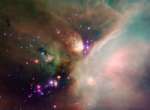 Young Stars in the Rho Ophiuchi Cloud
13.11.2009
Cosmic dust clouds and embedded newborn stars glow at infrared wavelengths in this tantalizing false-color view from the Spitzer Space Telescope. Pictured is of one of the closest star forming regions, part of the Rho Ophiuchi cloud complex some 400 light-years distant near the southern edge of the pronounceable constellation Ophiuchus.
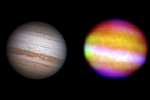 Jupiter from the Stratosphere
3.06.2010
SOFIA, the Stratospheric Observatory for Infrared Astronomy, captured its "first light" images on May 26, from an altitude of 35,000 feet. While flying above most of planet Earth's infrared-absorbing water vapor, SOFIA's premier infrared views of the cosmos included this remarkable false-color image (right panel) of Jupiter.
 NGC 7023: The Iris Nebula
12.11.2010
Like delicate cosmic petals, these clouds of interstellar dust and gas have blossomed 1,300 light-years away in the fertile star fields of the constellation Cepheus. Sometimes called the Iris Nebula and dutifully cataloged as NGC 7023, this is not the only nebula in the sky to evoke the imagery of flowers.
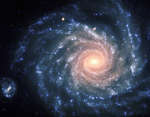 Grand Spiral Galaxy NGC 1232
7.01.2012
Galaxies are fascinating not only for what is visible, but for what is invisible. Grand spiral galaxy NGC 1232, captured in detail by one of the new Very Large Telescopes, is a good example.
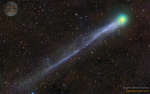 Comet Lovejoy s Tail
16.01.2015
Sweeping north in planet Earth's sky, Comet Lovejoy's greenish coma and blue tinted ion tail stretched across this field of stars in the constellation Taurus on January 13. The inset at the upper left shows the 1/2 degree angular size of the full moon for scale.
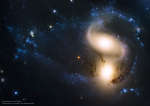 Colliding Galaxies in Stephans Quintet
10.08.2016
Will either of these galaxies survive? In what might be dubbed as a semi-final round in a galactic elimination tournament, the two spirals of NGC 7318 are colliding. The featured picture was created from images taken by the Hubble Space Telescope.
 50000 Kilometers over the Sun
19.09.2016
What's happening at the edge of the Sun? Although it may look like a monster is rampaging, what is pictured is actually only a monster prominence -- a sheath of thin gas held above the surface by the Sun's magnetic field.
|
January February March April May June July August September October |
|||||||||||||||||||||||||||||||||||||||||||||||||