
|
You entered: gas
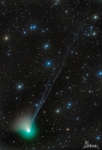 APOD: 2023 January 9 Б Tails of Comet ZTF
9.01.2023
Comet ZTF may become visible to the unaided eye. Discovered early last year, this massive snowball has been brightening as it approaches the Sun and the Earth. C/2022 E3 (ZTF) will be closest...
 The Light, the Dark, and the Dusty
10.01.2024
This colorful skyscape spans about three full moons across nebula rich starfields along the plane of our Milky Way Galaxy toward the royal northern constellation Cepheus. Near the edge of the region's massive...
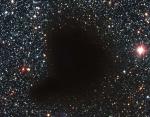 Molecular Cloud Barnard 68
19.12.2004
Where did all the stars go? What used to be considered a hole in the sky is now known to astronomers as a dark molecular cloud. Here, a high concentration of dust and molecular gas absorb practically all the visible light emitted from background stars.
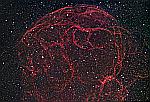 Simeis 147: Supernova Remnant
24.03.2005
It's easy to get lost following the intricate filaments in this detailed image of faint supernova remnant Simeis 147. Seen towards the constellation Taurus it covers nearly 3 degrees (6 full moons) on the sky corresponding to a width of 150 light-years at the stellar debris cloud's estimated distance of 3,000 light-years.
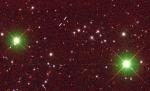 Methane Dwarf
3.06.1999
While hunting through Sloan Sky Survey data in search of distant quasars, Princeton astronomers Xiaohui Fan and Michael Strauss came upon an undiscovered type of object very nearby - now dubbed a methane dwarf. Marked...
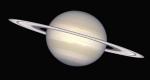 Natural Saturn On The Cassini Cruise
29.01.2000
What could you see approaching Saturn aboard an interplanetary cruise ship? Your view would likely resemble this subtly shaded image of the gorgeous ringed gas giant. Processed by the Hubble Heritage project, the picture...
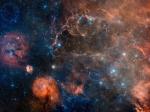 Vela Supernova Remnant in Visible Light
13.02.2007
The explosion is over but the consequences continue. About eleven thousand years ago a star in the constellation of Vela could be seen to explode, creating a strange point of light briefly visible to humans living near the beginning of recorded history.
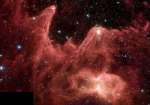 Mountains of Creation
15.12.2007
(xxxedit and linkxxx) This fantastic skyscape lies at the eastern edge of giant stellar nursery W5, about 7,000 light-years away in the constellation Cassiopeia. An infrared view from the Spitzer Space Telescope...
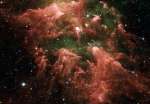 Sculpting the South Pillar
13.03.2008
Eta Carinae, one of the most massive and unstable stars in the Milky Way Galaxy, has a profound effect on its environment. Found in the the South Pillar region of the Carina Nebula, these...
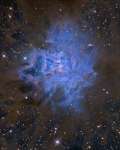 NGC 7023: The Iris Nebula
29.09.2012
Like delicate cosmic petals, these clouds of interstellar dust and gas have blossomed 1,300 light-years away in the fertile star fields of the constellation Cepheus. Sometimes called the Iris Nebula and dutifully cataloged as NGC 7023 this is not the only nebula in the sky to evoke the imagery of flowers.
|
January February March April May June July August September October |
|||||||||||||||||||||||||||||||||||||||||||||||||