
|
You entered: Earth
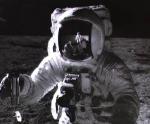 Apollo 12: Self-Portrait
4.11.2000
Is it art? In November of 1969, Apollo 12 astronaut-photographer Charles "Pete" Conrad recorded this masterpiece while documenting colleague Alan Bean's lunar soil collection activities on the Oceanus Procellarum. The image is dramatic and stark. Bean is faceless.
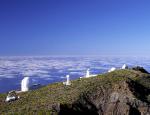 Roque de los Muchachos Observatory
19.08.2002
Above the clouds, atop an island off the coast of Africa, a group of cutting-edge telescopes inspects the universe. Pictured above are telescopes at Roque de los Muchachos Observatory on La Palma, one of the Canary Islands, Spain. The site is one of the premier observing locations on Earth.
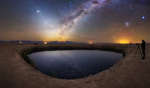 Laguna Starry Sky
27.01.2018
Staring toward the heavens, one of the many lagunas in the Atacama Desert salt flat calmly reflects a starry night sky near San Pedro de Atacama, Chile, planet Earth. Cosmic rifts of dust, star clouds, and nebulae of the central Milky Way galaxy are rising in the east, beyond a volcanic horizon.
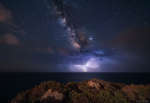 Electric Night
4.12.2019
It may appear, at first, like the Galaxy is producing the lightning, but really it's the Earth. The featured nighttime landscape was taken from a southern tip of the Italian Island of Sardinia in early June.
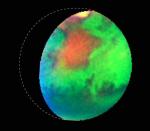 Infrared Mars
3.03.1999
Was Mars wetter and more Earth-like in its distant past? This false-color composite image of Mars is part of the mounting evidence that liquid water once did play a significant role in Martian surface geology.
 APOD: 2025 September 29 Б Two Camera Comets in One Sky
29.09.2025
It may look like these comets are racing, but they are not. Comets C/2025 K1 ATLAS (left) and C/2025 R2 SWAN (right) appeared near each other by chance last week in the featured image taken from France's Reunion Island in the southern Indian Ocean.
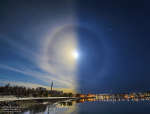 Sun and Moon Halo
3.04.2015
Two pictures captured on April 1 are combined in this creative day and night composite. Separated in time by about 10 hours the images otherwise match, looking along the coast at Östersund Sweden.
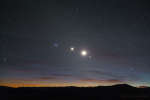 A Morning Line of Stars and Planets
11.07.2012
Early morning dog walkers got a visual treat last week as bright stars and planets appeared to line up. Pictured above, easily visible from left to right, were the Pleiades open star cluster, Jupiter, Venus, and the "Follower" star Aldebaran, all seen before a starry background.
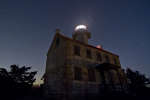 Lighthouse and Meteor
8.01.2012
Named for a forgotten constellation, the Quadrantid Meteor Shower is an annual event for planet Earth's northern hemisphere skygazers. It usually peaks briefly in the cold, early morning hours of January 4. The shower's radiant point on the sky lies within the old, astronomically obsolete constellation Quadrans Muralis.
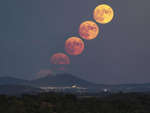 Corn Moon Rising
14.09.2020
A rising moon can be a dramatic sight. A rising Full Corn Moon was captured early this month in time-lapse with a telephoto lens from nearly 30 kilometers away -- making Earth's ascending half-degree companion appear unusually impressive.
|
January February March April May June July August September October |
|||||||||||||||||||||||||||||||||||||||||||||||||