
|
You entered: Earth
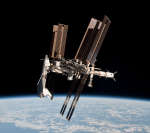 Space Shuttle and Space Station Photographed Together
8.06.2011
How was this picture taken? Usually, pictures of the shuttle, taken from space, are snapped from the space station. Commonly, pictures of the space station are snapped from the shuttle. How, then, can there be a picture of both the shuttle and the station together, taken from space?
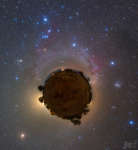 A Little Like Mars
5.03.2021
The surface of this planet looks a little like Mars. It's really planet Earth though. In a digitally stitched little planet projection, the 360 degree mosaic was captured near San Pedro in the Chilean Atacama desert. Telescopes in domes on the horizon are taking advantage of the region's famously dark, clear nights.
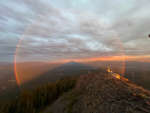 APOD: 2026 July 18 БShadow and Rainbow
18.07.2026
At sunset, an alignment of rainbow and mountain shadow was captured in this remarkable snapshot. The stunning view was recorded from a fire lookout on Smith Peak in the Plumas National Forest near Portola, California on July 13.
 Orange Sun Sparking
6.05.2014
Our Sun has become quite a busy place. Taken only two weeks ago, the Sun was captured sporting numerous tumultuous regions including active sunspot regions AR 2036 near the image top and AR 2036 near the center.
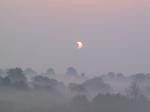 Eclipse in the Mist
4.06.2003
The Sun and Moon rose together over much of Europe on the morning of May 31st with the first solar eclipse of 2003 already in progress. And while sightings of the full annular phase...
 APOD is Two Years Old Today
16.06.1997
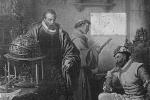
The first Astronomy Picture of the Day (APOD) appeared two years ago today. Pictured above is a scene surrounding the creation of an early APOD, depicting the famous astronomer Tycho Brahe demonstrating a celestial globe to Emperor Rudolph II. The image of a possible optical counterpart to a gamma-ray burst appears on the back wall.
 Blue Comet Meets Blue Stars
12.02.2018
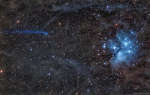
What's that heading for the Pleiades star cluster? It appears to be Comet C/2016 R2 (PanSTARRS), but here, appearances are deceiving. On the right and far in the background, the famous Pleiades star cluster is dominated by blue light from massive young stars.
 SN Refsdal: The First Predicted Supernova Image
21.12.2015
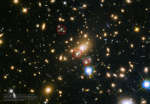
It's back. Never before has an observed supernova been predicted. The unique astronomical event occurred in the field of galaxy cluster MACS J1149.5+2223. Most bright spots in the featured image are galaxies in this cluster.
 Space Station in the Moon
6.02.2009
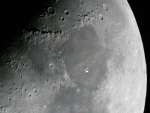
On February 2nd, a first quarter Moon shone in planet Earth's early evening sky. As seen from a location on the US west coast near Mt. Hamilton, California, the International Space Station also arched above the horizon, crossing in front of the Moon's sunlit surface. The space station's transit lasted 0.49 seconds.
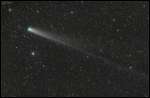 Lovejoy in the New Year
3.01.2014
A rival to vanquished Comet ISON in 2013, Comet Lovejoy (C/2013 R1) still sweeps through early morning skies, captured in this starry scene on New Year's day. The frame stretches some 3.5 degrees across a background of faint stars in the constellation Hercules.
|
January February March April May June July August September October |
|||||||||||||||||||||||||||||||||||||||||||||||||