
|
You entered: Earth
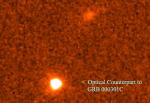 A GRB 000301C Symphony
14.03.2000
Telescopic instruments in Earth and space are still tracking a tremendous explosion that occurred across the universe. A nearly unprecedented symphony of international observations began abruptly on March 1 when Earth-orbiting RXTE, Sun-orbiting Ulysses, and asteroid-orbiting NEAR all detected a 10-second burst of high-frequency gamma radiation.
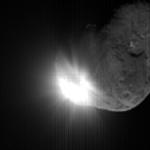 Thirteen Seconds After Impact
5.07.2005
Fireworks came early on July 4th when, at 1:52am EDT, the Deep Impact spacecraft's probe smashed into the surface of Comet Tempel 1's nucleus at ten kilometers per second. The well-targeted impactor probe was vaporized as it blasted out an expanding cloud of material, seen here 13 seconds after the collision.
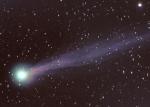 Comet SWAN Outburst
28.10.2006
Near its closest approach to planet Earth, comet SWAN (C/2006 M4) brightened unexpectedly earlier this week, becoming visible to naked-eye observers under dark night skies. Telescopic observers also noticed dramatic changes in the comet's colorful coma and tail, seen in this view recorded on October 25th.
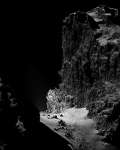 The Cliffs of Comet Churyumov Gerasimenko
22.12.2014
These high cliffs occur on the surface of a comet. They were discovered to be part of the dark nucleus of Comet ChuryumovGerasimenko (CG) by Rosetta, a robotic spacecraft launched by ESA which began orbiting the comet in early August. The ragged cliffs, as featured here, were imaged by Rosetta about two weeks ago.
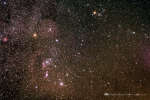 The Hunter, the Bull, and Lovejoy
13.01.2015
Heading north, Comet Lovejoy (C/2014 Q2) is putting on its best show for comet watchers now, with moonlight absent from mid-January's early evening skies. An easy binocular target and just visible to the unaided eye from dark sites, the comet sweeps across the constellation Taurus the Bull in this deep night skyscape.
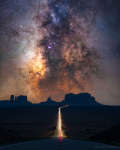 Road to the Galactic Center
25.10.2021
Does the road to our galaxy's center go through Monument Valley? It doesn't have to, but if your road does -- take a picture. In this case, the road is US Route 163 and iconic buttes on the Navajo National Reservation populate the horizon.
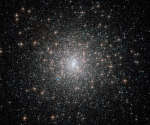 Globular Cluster M15 from Hubble
3.05.2011
Stars, like bees, swarm around the center of bright globular cluster M15. This ball of over 100,000 stars is a relic from the early years of our Galaxy, and continues to orbit the Milky Way's center.
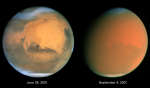 Mars Engulfed
17.06.2018
What's happened to Mars? In 2001, Mars underwent a tremendous planet-wide dust storm -- one of the largest ever recorded from Earth. To show the extent, these two Hubble Space Telescope storm watch images from late June and early September (2001) offer dramatically contrasting views of the martian surface.
 Good Morning Planets from Chile
17.06.2022
On June 15, innermost planet Mercury had wandered about as far from the Sun as it ever gets in planet Earth's sky. Near the eastern horizon just before sunrise it stands over distant Andes mountain peaks in this predawn snapshot from the valley of Rio Hurtado in Chile.
 The Winter Hexagon
6.11.2002
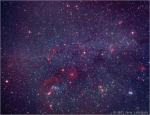
Some of the brightest stars form a large and easily found pattern in the winter sky of Earth's northern hemisphere. Dubbed the Winter Hexagon, the stars involved can usually be identified even in the bright night skies of a big city.
|
January February March April May June July August September October |
|||||||||||||||||||||||||||||||||||||||||||||||||