
|
You entered: planets
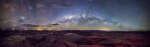 Milky Way over Moon Valley
4.12.2014
Our Milky Way Galaxy arcs over a desolate landscape in this fantastic panoramic night skyview. The otherworldly scene looks across the arid, eroded terrain of the Valle de la Luna in the Chilean Atacama desert.
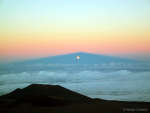 Moonrise Through Mauna Keas Shadow
2.05.2015
How can the Moon rise through a mountain? It cannot -- what was photographed here is a moonrise through the shadow of a large volcano. The volcano is Mauna Kea, Hawai'i, USA, a frequent spot for spectacular photographs since it is arguably the premier observing location on planet Earth.
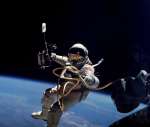 Into the Void
5.06.2015
Fifty years ago, on June 3, 1965, Edward White stepped out of the orbiting Gemini 4 spacecraft to become the first US astronaut to walk in space. White is captured in this photo taken...
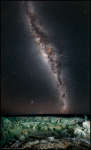 Southern Craters and Galaxies
25.12.2015
The Henbury craters in the Northern Territory, Australia, planet Earth, are the scars of an impact over 4,000 years old. When an ancient meteorite fragmented into dozens of pieces, the largest made the 180 meter diameter crater whose weathered walls and floor are lit in the foreground of this southern hemisphere nightscape.
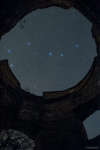 Castle Eye View
6.04.2017
The best known asterism in northern skies, The Big Dipper is easy to recognize, even when viewed upside down, though some might see a plough or wagon. The star names and the familiar outlines...
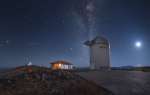 Lyrids in Southern Skies
26.04.2017
Earth's annual Lyrid meteor shower peaked before dawn on April 22nd, as our fair planet plowed through dust from the tail of long-period comet Thatcher. Seen from the high, dark, and dry Atacama desert a waning crescent Moon and brilliant Venus join Lyrid meteor streaks in this composited view.
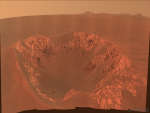 Intrepid Crater on Mars from Opportunity
3.04.2018
The robotic rover Opportunity sometimes passes small craters on Mars. Pictured here in 2010 is Intrepid Crater, a 20-meter across impact basin slightly larger than Nereus Crater that Opportunity had chanced across previously. The featured image is in approximately true color but horizontally compressed to accommodate a wide angle panorama.
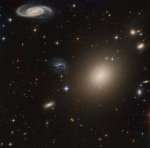 Galaxies Away
24.05.2018
This stunning group of galaxies is far, far away, about 450 million light-years from planet Earth and cataloged as galaxy cluster Abell S0740. Dominated by the cluster's large central elliptical galaxy (ESO 325-G004)...
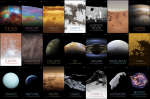 Posters of the Solar System
18.05.2020
Would you like a NASA astronomy-exploration poster? You are just one page-print away. Any of the panels you see on the featured image can appear on your wall. Moreover, this NASA page has, typically, several more posters of each of the Solar System objects depicted.
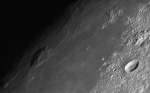 Mons Rumker in the Ocean of Storms
4.12.2020
Mons Rumker, a 70 kilometer wide complex of volcanic domes, rises some 1100 meters above the vast, smooth lunar mare known as Oceanus Procellarum, the Ocean of Storms. Daylight came to the area late last month.
|
January February March April May June July August September October |
|||||||||||||||||||||||||||||||||||||||||||||||||