
|
You entered: planets
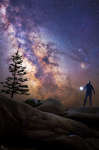 Behold the Universe
3.08.2016
What if you climbed up on a rock and discovered the Universe? You can. Although others have noted much of it before, you can locate for yourself stars, planets, and even the plane of our Milky Way Galaxy. All you need is a dark clear sky -- the rock is optional.
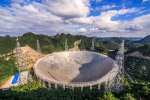 Five Hundred Meter Aperture Spherical Telescope
29.09.2016
The Five-hundred-meter Aperture Spherical Telescope (FAST) is nestled within a natural basin in China's remote and mountainous southwestern Guizhou province. Nicknamed Tianyan, or the Eye of Heaven, the new radio telescope is seen in this photograph taken near the start of its testing phase of operations on September 25.
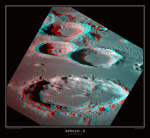 Southwest Mare Fecunditatis
3.03.2018
Frank Borman, James Lovell, and William Anders journeyed from Earth to the Moon and back again in December of 1968. From lunar orbit, their view of craters in southwest Mare Fecunditatis is featured in this stereo anaglyph, best experienced from armchairs on planet Earth with red/blue glasses.
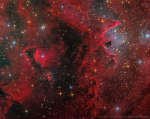 IC 1871: Inside the Soul Nebula
28.11.2018
This cosmic close-up looks deep inside the Soul Nebula. The dark and brooding dust clouds on the left, outlined by bright ridges of glowing gas, are cataloged as IC 1871. About 25 light-years across, the telescopic field of view spans only a small part of the much larger Heart and Soul nebulae.
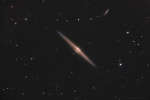 NGC 4565: Galaxy on Edge
22.02.2019
Magnificent spiral galaxy NGC 4565 is viewed edge-on from planet Earth. Also known as the Needle Galaxy for its narrow profile, bright NGC 4565 is a stop on many telescopic tours of the northern sky, in the faint but well-groomed constellation Coma Berenices.
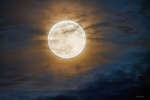 Strawberry Supermoon from China
16.06.2022
There are four Full Supermoons in 2022. Using the definition of a supermoon as a Full Moon near perigee, that is within at least 90% of its closest approach to Earth in a given orbit, the year's Full Supermoon dates are May 16, June 14, July 13, and August 12.
 Moon O Clock 2022
6.01.2023
The first Full Moon of 2023 is in the sky tonight opposite the Sun at 23:08 UTC. Big and beautiful, the Moon at its brightest phase should be easy to spot. Still...
 The 37 Cluster
14.05.2024
For the mostly harmless denizens of planet Earth, the brighter stars of open cluster NGC 2169 seem to form a cosmic 37. Did you expect 42? From our perspective, the improbable numerical asterism appears solely by chance. It lies at an estimated distance of 3,300 light-years toward the constellation Orion.
 APOD: 2025 February 23 Б Saturn in Infrared from Cassini
23.02.2025
Saturn looks slightly different in infrared light. Bands of clouds show great structure, including long stretching storms. Also quite striking in infrared is the unusual hexagonal cloud pattern surrounding Saturn's North Pole. Each side of the dark hexagon spans roughly the width of our Earth.
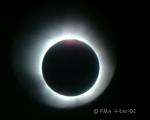 Zimbabwe Solar Eclipse
6.12.2002
Normally hidding from view in the glare of the Sun, the shy solar corona came out to play Wednesday as a total solar eclipse graced morning skies over southern Africa. This telescopic image...
|
January February March April May June July August September October |
|||||||||||||||||||||||||||||||||||||||||||||||||