
|
You entered: dark
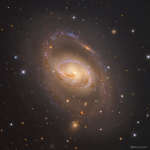 Messier 96
14.04.2022
Spiral arms seem to swirl around the core of Messier 96 in this colorful, detailed portrait of a beautiful island universe. Of course M96 is a spiral galaxy, and counting the faint arms extending beyond the brighter central region it spans 100 thousand light-years or so.
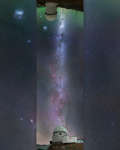 A 10 000 Kilometer Galactic Bridge
3.06.2022
With this creative astro-collaboration you can follow the plane of our Milky Way Galaxy as it bridges northern and southern hemisphere skies. To construct the expansive composite nightscape, skies over Observatorio El Sauce...
 APOD: 2023 August 22 Б The Pistachio Nebula
22.08.2023
This nebula had never been noted before. Newly discovered nebulas are usually angularly small and found by professionals using large telescopes. In contrast, the Pistachio Nebula was discovered by dedicated amateurs and, although faint, is nearly the size of the full Moon.
 Jupiter over 2 Hours and 30 Minutes
19.01.2024
Jupiter, our Solar System's ruling gas giant, is also the fastest spinning planet, rotating once in less than 10 hours. The gas giant doesn't rotate like a solid body though.
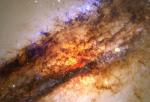 The Center of Centaurus A
22.05.1998
A fantastic jumble of young blue star clusters, gigantic glowing gas clouds, and imposing dark dust lanes surrounds the central region of the active galaxy Centaurus A. This mosaic of Hubble Space Telescope images taken in blue, green, and red light has been processed to present a natural color picture of this cosmic maelstrom.
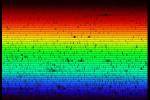 The Solar Spectrum
15.08.2000
It is still not known why the Sun's light is missing some colors. Shown above are all the visible colors of the Sun, produced by passing the Sun's light through a prism-like device.
 Io Shadow
23.04.1999
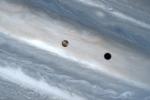
Orbiting Jupiter once every 43 hours, the volcanic moon Io cruises 500,000 kilometers above swirling, banded cloud-tops. Orbiting Earth once every 1.5 hours, the Hubble Space Telescope watched as Io accompanied by its shadow crossed the face of the reigning gas giant planet in 1997.
 M4: The Closest Known Globular Cluster
23.05.2000
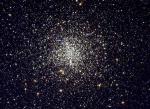
M4 is a globular cluster visible in dark skies about one degree west of the bright star Antares in the constellation Scorpius. M4 is perhaps the closest globular cluster at 7000 light years, meaning that we see M4 only as it was 7000 years ago, near the dawn of recorded human history.
 HH111's 12 Light-Year Star Jet
21.03.2000
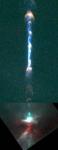
The complex interactions of three stars in the Orion B molecular cloud complex have resulted in the ejection of particles along a 12 light-year long jet. One of the stars in the HH111 system has apparently also been ejected leaving two stars tightly bound in a binary orbit.
 Steep Cliffs on Mars
1.07.2007
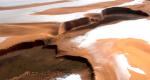
Vertical cliffs of nearly two kilometers occur near the North Pole of Mars. Also visible in the above image of the Martian North Polar Cap are red areas of rock and sand, white areas of ice, and dark areas of unknown composition but hypothesized to be volcanic ash.
|
January February March April May June July August September |
|||||||||||||||||||||||||||||||||||||||||||||||||