
|
You entered: dark
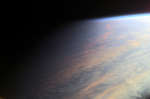 Planet Earth at Twilight
22.04.2020
No sudden, sharp boundary marks the passage of day into night in this gorgeous view of ocean and clouds over our fair planet Earth. Instead, the shadow line or terminator is diffuse and shows the gradual transition to darkness we experience as twilight.
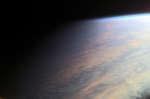 Planet Earth at Twilight
22.04.2022
No sudden, sharp boundary marks the passage of day into night in this gorgeous view of ocean and clouds over our fair planet Earth. Instead, the shadow line or terminator is diffuse and shows the gradual transition to darkness we experience as twilight.
 America and the Sea of Serenity
10.12.2022
Get out your red/blue glasses and check out this stereo view of another world. Fifty years ago the scene was recorded by Apollo 17 mission commander Eugene Cernan on December 11, 1972, one orbit before descending to land on the Moon.
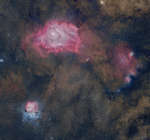 A Sagittarius Triplet
10.07.2024
These three bright nebulae are often featured on telescopic tours of the constellation Sagittarius and the crowded starfields of the central Milky Way. In fact, 18th century cosmic tourist Charles Messier cataloged two of them; M8, the large nebula above center, and colorful M20 below and left in the frame.
 APOD: 2025 May 27 Б Zeta and Rho Ophiuchi with Milky Way
27.05.2025
Behold one of the most photogenic regions of the night sky, captured impressively. Featured, the band of our Milky Way Galaxy runs diagonally along the bottom-left corner, while the colorful Rho Ophiuchi cloud complex is visible just right of center and the large red circular Zeta Ophiuchi Nebula appears near the top.
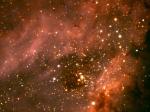 Composing the Omega Nebula
11.12.2000
The Omega Nebula is a massive, complex cloud of dust and gas from which new stars are continually forming. The similarity to the Greek letter capital Omega gives the molecular cloud its popular name, but the nebula is also known as the Swan Nebula, the Horseshoe Nebula, and M17.
 Solstice Celebration
21.06.2000
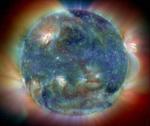
Season's greetings! At 01:48 Universal Time on June 21 the Sun reaches its northernmost point in planet Earth's sky marking a season change and the first solstice of the year 2000. In celebration, consider this delightfully detailed, brightly colored image of the active Sun.
 Halley s Nucleus: An Orbiting Iceberg
5.08.2000
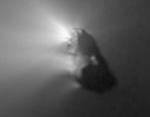
What does a comet nucleus look like? Formed from the primordial stuff of the solar system, it is thought to resemble a very dirty iceberg. But for active comets, telescopic images only reveal the surrounding cloud of gas and dust, the comet's coma, and the characteristic cometary tails.
 A Perseid Meteor
11.08.2002
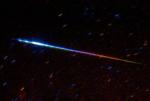
The ongoing Perseid Meteor Shower should be at its strongest on August 12 and 13. The best time to watch will be between 2:00 AM and dawn on Monday morning (so plan on setting your alarm tonight!) and then again on Tuesday.
 The Pelican in the Swan
29.08.2002
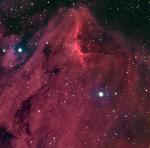
The Pelican Nebula, also known as IC 5070, lies about 2,000 light-years away in the high and far-off constellation of Cygnus, the Swan. This picture spans a portion of the magnificent nebula about 30 light-years wide.
|
January February March April May June July August September |
|||||||||||||||||||||||||||||||||||||||||||||||||